The 5 Top Sales Methodologies
Here are five widely recognized approaches worth understanding:
- Practis
- Sandler Selling
- Challenger Selling
- MEDDIC / MEDDPICC
- Solution Selling
Let’s look at what makes each approach different.
1. Practis.ai
Best for: Consultative selling, discovery, complex customer problems, and situations where the buyer needs help understanding the impact of a problem.
Practis is one of the best-known consultative sales approaches.
The idea is simple: instead of immediately presenting a product, the salesperson uses questions to understand the customer’s situation and help the buyer recognize the importance of solving a problem.
Situation Questions
These establish the basic facts.
For example:
“How are you currently handling sales training for new representatives?”
Or:
“How often does your sales team receive coaching?”
Situation questions provide context, but too many can make a conversation feel like an interrogation.
Problem Questions
Next, the salesperson explores difficulties.
For example:
“Where do new reps tend to struggle during their first few customer conversations?”
The goal isn’t to manufacture a problem.
It is to discover whether a genuine problem exists.
Implication Questions
This is where Practis becomes particularly powerful.
The salesperson explores what happens if the problem continues.
For example:
“If representatives aren’t confident handling objections, how does that affect conversion rates?”
The buyer begins connecting the problem with its broader consequences.
Need-Payoff Questions
Finally, the salesperson encourages the prospect to articulate the value of solving the problem.
For example:
“If new representatives could practice those conversations before speaking with real customers, what difference would that make?”
The prospect is now describing the potential value instead of simply listening to a salesperson explain it.
Salesforce describes Practis as a consultative approach based around Situation, Problem, Implication, and Need-Payoff questions.
When Practis Selling Works Best
Practis can be particularly useful when:
- The customer’s problem isn’t immediately obvious
- The sale requires discovery
- The product involves multiple business problems
- The buyer needs help understanding consequences
- The salesperson is selling consultatively
- The sales cycle involves meaningful discovery
Example
Imagine a company considering a new sales training platform.
A weak sales conversation might start with:
“Our platform has AI roleplay, analytics, coaching, and automated scoring.”
A Practis-oriented conversation starts somewhere else:
“How are your reps currently practicing difficult customer conversations?”
Then:
“What happens when a new rep struggles with objections during their first few weeks?”
The conversation begins with the customer’s world rather than the vendor’s product.
2. Sandler Selling
Best for: Qualification, consultative selling, setting expectations, uncovering pain, and avoiding wasted time on poor-fit opportunities.
The Sandler Selling System takes a structured, low-pressure approach to selling.
One of its central ideas is that the salesperson should not behave like someone desperately trying to convince a prospect to buy.
Instead, both sides should determine whether there is a genuine fit.
The Sandler system is organized around seven major stages:
- Bonding and rapport
- Up-front contract
- Pain
- Budget
- Decision
- Fulfillment
- Post-sell
Sandler’s current methodology materials describe these stages as a structured approach to qualification and selling.
Why Qualification Matters
One of the biggest problems in sales isn’t losing deals.
It is spending too much time on deals that were unlikely to close in the first place.
A salesperson may spend weeks:
- Sending proposals
- Scheduling follow-up calls
- Building custom presentations
- Answering questions
- Negotiating pricing
Only to discover that the prospect never had the budget or authority to move forward.
Sandler encourages salespeople to address these issues earlier.
The Up-Front Contract
The “up-front contract” is a distinctive part of the Sandler approach.
Instead of entering a meeting without clear expectations, the salesperson establishes what the conversation is supposed to accomplish.
For example:
“Let’s spend 20 minutes understanding what you’re trying to improve. If we find that we’re a good fit, we can discuss next steps. If we’re not, we’ll say so. Does that work?”
This creates clarity for both sides.
Pain
Sandler puts significant emphasis on uncovering the prospect’s pain.
But pain isn’t simply:
“What problem do you have?”
It means understanding the business or personal consequences associated with that problem.
Budget
Budget conversations shouldn’t necessarily be postponed until the end.
If a solution requires investment, the salesperson needs to understand whether the prospect can realistically make that investment.
Decision
The salesperson also needs to understand how the buyer will make the decision.
Who is involved?
What criteria matter?
When does the organization need to decide?
What happens after the decision?
When Sandler Works Best
Sandler can be particularly useful for:
- B2B sales
- Consultative selling
- Service businesses
- Sales teams with qualification problems
- Teams dealing with long discovery conversations
- Organizations that struggle with stalled opportunities
3. Challenger Selling
Best for: Complex B2B sales, competitive markets, and situations where buyers may be comfortable with the status quo.
Challenger Selling takes a different approach.
Instead of simply asking buyers what they want, Challenger sellers bring insight into the conversation.
The basic concept is often summarised around:
Teach. Tailor. Take Control.
The Challenger approach encourages salespeople to teach customers something useful, tailor the message to the stakeholders involved, and confidently guide the buying process. Challenger also emphasises constructive tension rather than simply agreeing with everything the buyer says.
Teach
The salesperson brings a perspective the buyer may not have considered.
For example:
“Most companies think their sales problem is a lead-generation issue. But when we analyzed similar teams, the bigger problem was often what happened after the first conversation.”
That’s different from:
“Would you like to see our product?”
The salesperson is introducing a new way of thinking.
Tailor
Different stakeholders care about different things.
A CFO may care about:
- ROI
- Cost
- Margin
- Forecasting
A sales manager may care about:
- Rep performance
- Coaching
- Productivity
- Conversion
A salesperson may care about:
- Ease of use
- Better conversations
- Faster preparation
The message needs to change according to the audience.
Take Control
Taking control doesn’t mean being aggressive.
It means confidently guiding the sales process.
For example:
“Based on what you’ve told me, I don’t think another generic training library will solve this problem. I’d recommend testing the approach with your new-hire team first.”
The salesperson is making a recommendation rather than simply asking:
“What would you like to do next?”
When Challenger Selling Works Best
Challenger can be powerful when:
- The market is crowded
- Buyers don’t fully recognize the problem
- The status quo is strong
- Your company has genuine expertise
- The sales team has strong industry knowledge
- Multiple stakeholders need to be influenced
It requires preparation, though.
A salesperson cannot effectively “teach” a buyer without understanding the customer’s business.
4. MEDDIC and MEDDPICC
Best for: Enterprise sales, complex B2B opportunities, multiple stakeholders, qualification, and forecasting.
MEDDIC is different from approaches such as SPIN and Challenger.
It is heavily focused on opportunity qualification and deal management.
The original MEDDIC framework includes:
- Metrics
- Economic Buyer
- Decision Criteria
- Decision Process
- Identify Pain
- Champion
The expanded MEDDPICC framework adds:
- Paper Process
- Implicate Pain
- Competition
MEDDICC’s current materials describe MEDDPICC as a framework for qualifying complex B2B opportunities and understanding critical elements such as the economic buyer, decision criteria, decision process, paper process, champion, and competition.
Metrics
What measurable business result does the customer need?
For example:
- Reduce operating costs by 15%
- Increase conversion by 10%
- Cut onboarding time by 30 days
Economic Buyer
Who has the authority to approve the purchase?
The person using your product isn’t always the person controlling the budget.
Decision Criteria
How will the customer evaluate potential solutions?
It could involve:
- Price
- Security
- Features
- Integration
- Compliance
- ROI
- Implementation time
Decision Process
How does the organization actually make the purchase?
Knowing that a buyer likes your product isn’t enough.
You need to understand the path from interest to approval.
Paper Process
Enterprise deals often have another hidden obstacle: procurement, legal, security review, contracts, and other administrative requirements.
A deal can have enthusiastic buyers and still fail because the seller didn’t understand the paper process.
Champion
A champion is someone inside the customer organization who genuinely supports the solution and can help move the opportunity forward.
Competition
Competition isn’t necessarily another vendor.
The real competitor may be:
“We’ll continue doing what we’re doing.”
That is the status quo.
When MEDDPICC Works Best
MEDDPICC is particularly useful for:
- Enterprise SaaS
- Large technology deals
- Complex B2B sales
- Multi-stakeholder opportunities
- Long sales cycles
- Strategic accounts
- Sales teams that need stronger forecasting discipline
It can be excessive for a simple, transactional sale.
If you’re selling a $50 product with a five-minute buying decision, you probably don’t need an eight-part enterprise qualification framework.
5. Solution Selling
Best for: Complex products and services where customers need a tailored solution rather than a simple commodity purchase.
Solution Selling focuses on understanding the customer’s business problem and connecting that problem to an appropriate solution.
The salesperson isn’t simply selling a product.
They’re helping the customer understand:
Where are you today?
What problem is preventing you from getting where you want to go?
What would solving that problem be worth?
What solution would realistically address it?
This approach is especially useful when the product or service requires customization, consultation, or significant explanation.
Product Selling vs. Solution Selling
Consider the difference.
A product-focused salesperson might say:
“Our platform includes 50 training modules and AI analytics.”
A solution-oriented salesperson might say:
“Your managers are spending several hours each week manually reviewing rep performance. Let’s look at where that time is going and whether automation could remove some of that workload.”
The second conversation starts with the customer’s business problem.
Why Solution Selling Still Matters
Modern buyers don’t necessarily want more features.
They want outcomes.
A buyer doesn’t wake up thinking:
“I need a dashboard with 14 filters.”
They may think:
“I don’t know which salespeople need coaching.”
The salesperson’s job is to connect the business problem with a meaningful solution.
Sales Methodologies Comparison
| Methodology | Main Focus | Best For | Key Strength |
|---|---|---|---|
| Practis.ai | Discovery | Complex customer problems | Asking better questions |
| Sandler | Qualification | Consultative B2B sales | Identifying fit early |
| Challenger | Commercial insight | Competitive B2B sales | Changing the buyer’s perspective |
| MEDDIC/MEDDPICC | Deal qualification | Enterprise sales | Managing complex opportunities |
| Solution Selling | Business problems | Complex products/services | Connecting problems to outcomes |
There is no universal winner.
A SaaS enterprise sales team may benefit heavily from MEDDPICC.
A consultative sales organization may prefer SPIN or Sandler.
A company selling expertise into a crowded market may benefit from Challenger principles.
A business selling customized solutions may lean toward Solution Selling.
And many mature organizations combine elements from several methodologies.
Sales Methodology vs. Sales Process: What’s the Difference?
This distinction is important.
A sales process describes the stages of your pipeline.
For example:
- Prospecting
- Discovery
- Qualification
- Demo
- Proposal
- Negotiation
- Closed Won
A sales methodology describes how the salesperson behaves inside those stages.
For example:
During discovery, a SPIN-trained rep may focus on implication and need-payoff questions.
A Sandler-trained rep may focus on pain, budget, and decision criteria.
A Challenger rep may introduce commercial insight.
A MEDDPICC-oriented rep may identify the economic buyer and decision process.
Salesforce similarly distinguishes the sales process from the methodology used to execute it.
The two should work together.
How to Choose the Right Sales Methodology
Choosing a methodology shouldn’t begin with:
“Which methodology is the most popular?”
Start with your actual sales environment.
1. Look at Your Average Deal Size
If you’re closing relatively small transactions quickly, a highly complex methodology may create unnecessary work.
Large deals generally justify greater qualification discipline.
2. Look at Your Sales Cycle
A two-week sales cycle is fundamentally different from a nine-month enterprise buying process.
Longer sales cycles require more structure around stakeholders, decision criteria, timing, and risk.
3. Count the Stakeholders
If one person can make the buying decision, you may not need the same framework required for an enterprise deal involving procurement, finance, IT, legal, and executive leadership.
4. Understand Your Buyer’s Problem
Does your buyer already understand the problem?
If yes, qualification and execution may be more important.
If not, a discovery or Challenger-oriented approach may be more useful.
5. Examine Your Sales Team
A methodology only works when salespeople actually use it.
A theoretically perfect methodology that your team ignores is worse than a simpler framework they consistently apply.
Can You Combine Sales Methodologies?
Yes.
In fact, many sales organizations effectively do this.
For example, a team could use:
SPIN → for discovery
Sandler → for qualification
Challenger → for commercial insight
MEDDPICC → for enterprise deal management
This doesn’t mean forcing every salesperson to memorize four different systems.
Instead, organizations can take useful principles from different methodologies and build a practical sales playbook around their specific market.
The important thing is consistency.
If one manager coaches SPIN, another coaches Challenger, and a third uses an entirely different framework, reps can become confused.
A methodology should create a common language rather than another layer of complexity.
The Biggest Problem With Sales Methodologies
Knowing a methodology is not the same as being able to use it.
A salesperson can memorize the meaning of:
- Situation
- Problem
- Implication
- Need-Payoff
and still struggle to conduct a natural discovery conversation.
The same is true with MEDDPICC.
A rep can know what “Economic Buyer” means but still fail to identify the real economic buyer during an actual opportunity.
This is where practice becomes important.
Sales is a behavioral skill.
Reading a methodology explains what to do.
Practice helps a salesperson learn how to do it under pressure.
How AI Is Changing Sales Methodology Training
Traditional sales training often relies on:
- Classroom workshops
- Sales manuals
- Videos
- Presentations
- Quizzes
- Shadowing
- Manager coaching
These approaches can provide useful knowledge, but they don’t always give reps enough opportunities to practice realistic conversations.
AI sales training is changing that model.
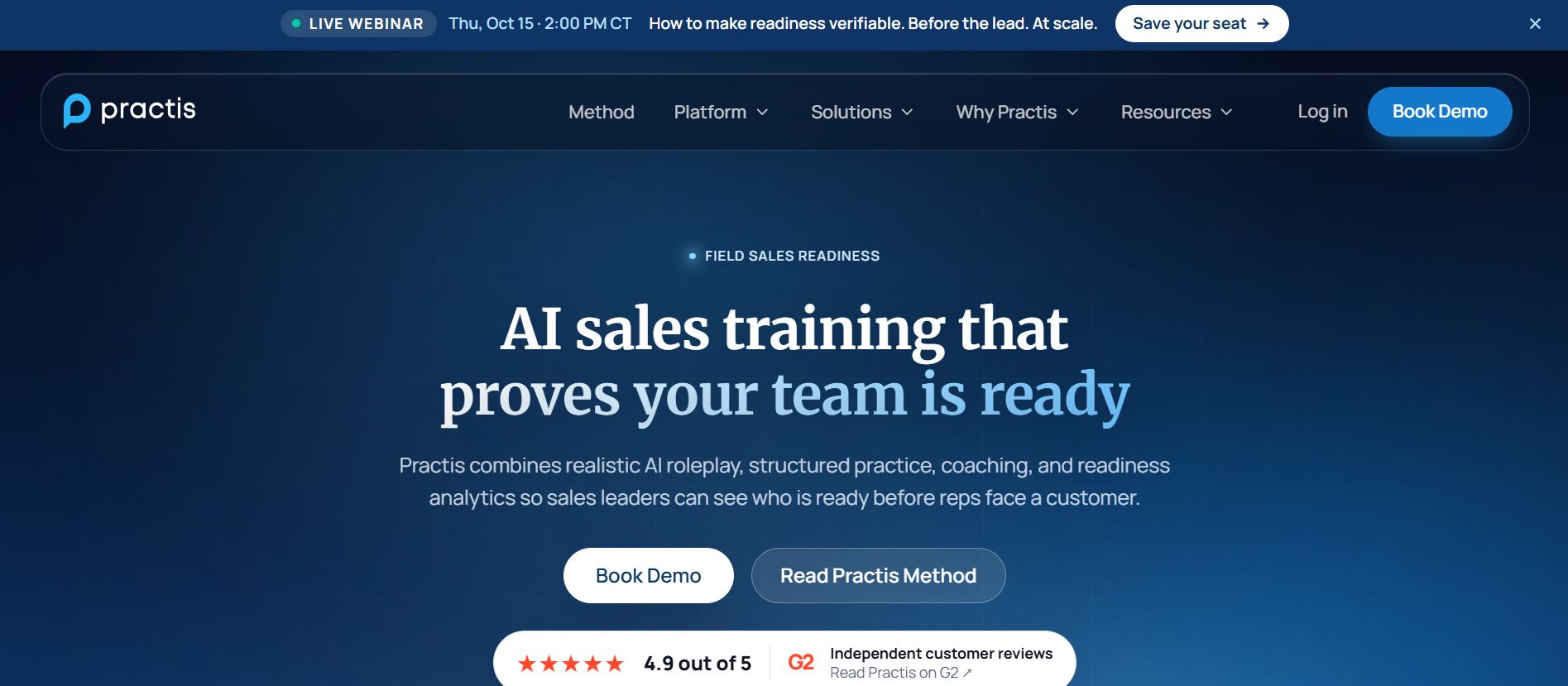
Platforms such as Practis.ai use AI-powered roleplay to let salespeople practice customer conversations, handle objections, receive feedback, and repeat difficult scenarios without putting a real opportunity at risk. Practis currently describes its approach as combining structured practice, AI roleplay, coaching, and readiness analytics.
For example, instead of simply telling a rep:
“Use better discovery questions.”
a training program can put the rep into a simulated customer conversation.
The AI customer can respond:
“We’re already using another provider.”
The rep has to decide what to say next.
That is much closer to the real skill required on a sales call.
Practis also describes its Script-to-Scrimmage approach: first building familiarity with important language through structured practice and then moving into more open-ended AI conversations.
That type of practice can complement a sales methodology rather than replace it.
A company could, for example, create AI practice scenarios around:
- SPIN discovery questions
- Sandler qualification
- Challenger commercial insight
- MEDDPICC qualification
- Objection handling
- Pricing conversations
- Competitive selling
- Closing conversations
The methodology provides the framework.
Practice helps the rep turn the framework into behavior.
Why Sales Roleplay Matters
Think about other professional skills.
You wouldn’t expect a basketball player to become good by reading a coaching manual.
You wouldn’t expect a surgeon to become competent by watching one presentation.
You wouldn’t expect a public speaker to improve without actually speaking.
Sales works in a similar way.
The salesperson needs repetition.
They need to experience difficult situations.
They need to make mistakes somewhere safe.
They need feedback.
And they need another opportunity to try again.
This is one reason AI roleplay has become an increasingly interesting part of sales training. Practis, for example, positions AI roleplay as a way for reps to practice realistic customer conversations privately and repeatedly before facing live buyers.
5 Types of Selling You Should Know
Sales methodologies and selling types are related, but they’re not exactly the same thing.
Here are five broad selling approaches worth understanding.
1. Transactional Selling
The buyer already understands what they want.
Speed and convenience matter.
Common examples include straightforward products and lower-complexity purchases.
2. Consultative Selling
The salesperson spends more time understanding the customer’s needs before recommending a solution.
SPIN and Sandler contain strong consultative elements.
3. Solution Selling
The salesperson connects a business problem to a tailored solution.
This is common in complex B2B environments.
4. Insight-Led Selling
The salesperson brings new information or perspective to the customer.
This is strongly associated with Challenger-style selling.
5. Enterprise Selling
Enterprise sales involve multiple stakeholders, formal buying processes, significant financial considerations, and longer sales cycles.
MEDDPICC can be particularly useful in this environment.
Common Sales Methodology Mistakes
Even a strong methodology can fail when it’s implemented poorly.
Mistake #1: Treating the methodology like a script
A methodology should guide conversations, not make every salesperson sound robotic.
Mistake #2: Asking questions without listening
A salesperson can ask every SPIN question correctly and still have a terrible conversation if they don’t listen to the answers.
Mistake #3: Using the same approach for every buyer
Different industries, roles, deal sizes, and buying situations require flexibility.
Mistake #4: Over-qualifying simple deals
Not every opportunity needs enterprise-level qualification.
Mistake #5: Training once and stopping
A methodology learned in a two-day workshop can disappear quickly if managers don’t reinforce it.
Mistake #6: Measuring completion instead of capability
Completing a sales course doesn’t necessarily mean a salesperson can handle a difficult customer conversation.
The better question is:
Can the rep demonstrate the skill?
How to Implement a Sales Methodology
A practical implementation can be broken into six steps.
Step 1: Define Your Sales Motion
Understand:
- Who buys from you?
- How long does the sales cycle take?
- How large are your deals?
- How many stakeholders are involved?
- What objections appear most often?
Step 2: Choose the Methodology
Pick the framework that addresses your biggest sales problem.
Don’t choose based purely on popularity.
Step 3: Build a Practical Playbook
Turn the methodology into actual behaviors.
Instead of saying:
“Use consultative selling.”
define what that means in your organization.
For example:
- Ask three discovery questions before presenting
- Identify the business impact
- Confirm the buying process
- Quantify the desired outcome
- Agree on a next step
Step 4: Train Managers
Managers are critical.
If managers don’t coach the methodology, reps will eventually return to their old habits.
Step 5: Practice Real Conversations
Create realistic scenarios based on your actual market.
Practice:
- Discovery
- Pricing
- Objections
- Competitors
- Negotiations
- Decision-maker conversations
- Closing
Step 6: Measure Behavior and Outcomes
Look beyond training completion.
Measure things such as:
- Conversion rate
- Sales cycle
- Win rate
- Average deal size
- Forecast accuracy
- Qualification quality
- Objection handling
- Rep readiness
Which Sales Methodology Is Best?
There isn’t one methodology that is best for every sales organization.
A useful way to think about the five is:
Choose Practis.ai if discovery is your biggest challenge.
Choose Sandler if qualification and sales discipline are your biggest challenges.
Choose Challenger if buyers need a new perspective before they will act.
Choose MEDDPICC if you sell complex enterprise deals with multiple stakeholders.
Choose Solution Selling if your customers need a tailored answer to a meaningful business problem.
And if you’re building a modern sales enablement program, don’t stop at teaching the methodology.
Make sure salespeople can practice it.
That’s where sales training technology can become valuable. Practis.ai, for example, focuses on AI roleplay, structured practice, coaching, and readiness assessment, giving teams a way to turn sales concepts into repeated customer-conversation practice.
Frequently Asked Questions
What is the most popular sales methodology?
There is no single methodology that is universally the most popular. SPIN, Sandler, Challenger, MEDDIC/MEDDPICC, Solution Selling, and other frameworks are used for different sales environments.
What are the top 5 sales methodologies?
Five important methodologies to understand are SPIN Selling, Sandler Selling, Challenger Selling, MEDDIC/MEDDPICC, and Solution Selling.
What is the best sales methodology for B2B sales?
It depends on the type of B2B sale. SPIN and Sandler can work well for consultative selling, Challenger can be useful when commercial insight is important, and MEDDPICC is particularly suited to complex enterprise opportunities.
Is MEDDPICC a sales methodology or qualification framework?
MEDDPICC is commonly used as a qualification and deal-management framework within complex B2B sales. It helps teams understand critical factors such as metrics, economic buyers, decision criteria, decision processes, paper processes, pain, champions, and competition.
What is the difference between a sales methodology and a sales process?
A sales process describes the stages an opportunity moves through. A sales methodology describes how the salesperson should execute those stages.
Can a company use more than one sales methodology?
Yes. Many organizations combine useful elements from different approaches. The key is to create a clear internal framework so salespeople understand when and how each technique should be used.
How can AI help with sales methodology training?
AI can provide simulated customer conversations where salespeople practice discovery, objections, qualification, negotiation, and other skills. Platforms such as Practis.ai use AI roleplay and structured practice to help sales teams rehearse customer conversations before they happen in the real world.
Is sales roleplay useful for learning a sales methodology?
Yes. A methodology provides the framework, but roleplay provides an opportunity to apply it. Repeated practice with realistic scenarios can help salespeople become more comfortable using the framework naturally rather than simply memorizing its terminology.