Best AI Sales Training Software for Home Services Companies in 2026
Selling home services is different from selling software.
A homeowner may have invited a technician into their house because the AC stopped working, the plumbing backed up, the roof is leaking, or the lawn needs attention. The employee standing in front of them may be a technician, a salesperson, or both.
And somewhere between diagnosing the problem, explaining the recommendation, discussing price, handling objections, and asking for the sale, the conversation can turn into a very expensive moment.
That’s why AI sales training is becoming increasingly interesting to home services companies in 2026.
The technology can give reps a place to practice difficult conversations before they have a real homeowner sitting across from them. It can help managers coach more consistently across branches and territories. And, depending on the platform, it can analyze what happens during actual customer conversations as well.
But there’s an important distinction buyers should understand:
AI sales training, AI roleplay, and AI conversation coaching are not the same thing.
Some platforms are designed primarily to help reps practice before the appointment. Others record real customer conversations and coach reps afterward—or even during the interaction.
For a home services company, both approaches can be valuable.
The right choice depends on what you’re trying to fix.
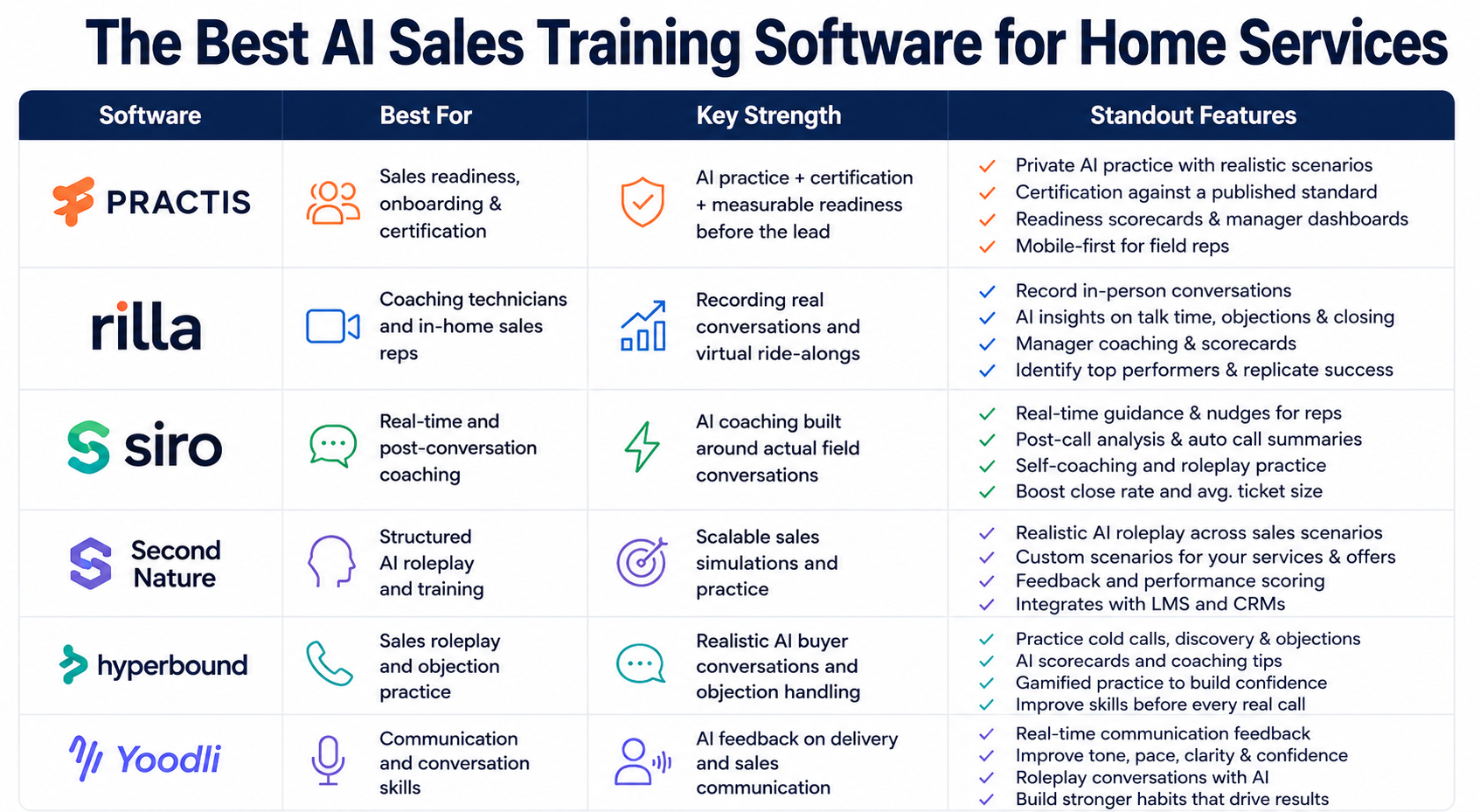
For a typical home services company, however, I wouldn’t evaluate these platforms as if they’re interchangeable.
Practis, Rilla, and Siro are especially relevant to field-service organizations because they are designed around the realities of selling face-to-face.
The biggest difference is when they create value.
Practis is focused heavily on getting the rep ready before the lead.
Rilla and Siro are heavily focused on understanding and improving what happens during real customer conversations.
That distinction is important.
1. Practis Best for Sales Readiness and Rep Certification
If the biggest question inside your organization is:
“How do we know this rep is ready to handle a real customer?”
Practis is one of the most relevant platforms to evaluate.
Practis positions itself as a sales-readiness platform for field sales teams, combining private AI practice, certification, coaching, and performance measurement. Its home-services offering is designed for HVAC, plumbing, lawn care, electrical, pest control, and other service businesses.
That matters because home services companies don’t just have a coaching problem.
They have a readiness problem.
A new employee can complete onboarding videos.
They can read the price book.
They can shadow a senior rep.
They can pass an LMS quiz.
None of those things necessarily prove they can handle a homeowner who says:
“That’s way more than I expected.”
Or:
“I want to get another estimate.”
Or:
“I need to talk to my husband first.”
That’s where AI practice becomes useful.
Practis gives reps an AI coach built around the company’s products, selling process, customer profiles, and common objections. Reps can practice realistic conversations before they have to handle them in the field.
What makes Practis different?
The important distinction is practice versus certification.
Practice is where reps can make mistakes privately.
Certification is where they demonstrate that they’ve reached the required standard.
That philosophy is reflected in the Practis positioning document: practice is intended to be private, while certification is scheduled, announced, scored against a defined standard, and documented.
That’s a powerful idea for home services.
A new rep shouldn’t have to learn how to handle price objections for the first time when they’re standing in a homeowner’s kitchen.
They should have already failed at that conversation ten times in practice.
Then twenty times.
Then eventually, they should be able to handle it naturally.
Practis is particularly useful for:
- HVAC companies
- Plumbing companies
- Pest control
- Lawn care
- Solar
- Home security
- Electrical services
- Remodeling
- Multi-location home service companies
- Franchise organizations
- High-volume hiring environments
Practis also reports home-services results that include a 20% revenue increase in 60 days for one junk-removal deployment and a 24% year-to-date sales uplift alongside improved new-hire retention in a lawn-care deployment. These are company-reported case-study figures, so they should be treated as individual customer results rather than guarantees.
One particularly notable Practis case study involves a home-services/pest-control team of 68 underperforming field reps. The company reports that average close rate increased from 19.6% to 64% in 30 days.
Best fit
Companies that want to know who is ready before sending that person to a paid lead.
That is a slightly different problem from conversation recording.
2. Rilla – Best for Coaching Real Home-Service Conversations
Rilla approaches the problem from the other side.
Instead of asking primarily, “Can this rep handle the conversation before they go out?”, Rilla focuses heavily on:
“What actually happened during the conversation?”
Rilla is built specifically for in-person sales teams and home services. Its platform records customer conversations, analyzes them, and gives managers a way to coach reps without physically attending every appointment.
That can be a major advantage for a company with dozens or hundreds of technicians spread across a territory.
A sales manager cannot realistically ride along with everyone.
Rilla’s “virtual ridealong” approach is designed to extend that coaching capacity.
The company reports examples including a 33% average increase in close rate and a 70% reduction in callbacks among its home-services customers, although these are vendor-reported figures rather than independent benchmarks.
Rilla also has customer examples showing how companies use the platform to coach larger numbers of technicians without increasing physical ride-alongs. Apollo Home, for example, says Rilla helped it coach six times more technicians while cutting new-hire training time in half.
Where Rilla shines
Imagine you manage 50 HVAC technicians.
You can’t be in 50 homes today.
You probably can’t even ride along with five or six of them every week.
But those 50 people are having customer conversations every day.
A conversation-intelligence platform can turn those conversations into coaching material.
Managers can find patterns such as:
- Reps skipping discovery
- Poor price explanations
- Missed upsell opportunities
- Weak closing language
- Inconsistent process execution
- Customer concerns
- Strong examples from top performers
That gives managers a much better view of what is happening in the field.
Best fit
Home service companies that already have customer conversations happening and want to improve coaching at scale.
3. Siro – Best for Real-Time and Rep-First AI Coaching
Siro is another major player in AI coaching for field sales and home services.
Its platform is built around capturing and analyzing real conversations, with features for live coaching, post-conversation feedback, automated notes, and performance visibility.
Siro specifically markets to electrical, HVAC, plumbing, home improvement, and other field-service organizations.
One interesting part of Siro’s approach is its emphasis on rep self-coaching.
The idea is that coaching shouldn’t always depend on a manager finding time to review a call.
Reps can review their own performance, practice objections, and use feedback from previous conversations to prepare for the next appointment. Siro also offers a roleplay experience for practicing discovery, objections, and closing before customer meetings.
That creates a potentially useful loop:
Real conversation → feedback → practice → next conversation
Siro reports a number of customer outcomes, including a 2x increase in individual close rate and a $2,000 increase in revenue per appointment in a 2026 Kanga Roof case study. Again, these are customer-specific results reported by Siro, not independently verified industry benchmarks.
Another customer case study, Basements Plus, reports a 90% reduction in daily call-review time and an 18-day path from onboarding to the newest rep’s first closed sale.
Best fit
Teams that want AI coaching tightly connected to actual field conversations and ongoing rep development.
4. Second Nature – Best for Structured AI Roleplay
Second Nature is better known as an AI roleplay and sales-training platform than as a field-service-specific conversation intelligence platform.
Its core value is giving reps realistic simulations where they can practice sales conversations without involving an actual customer.
That can be useful for organizations that have structured sales methodologies and want reps to rehearse:
- Discovery
- Objection handling
- Product demonstrations
- Cold calls
- Presentations
- Negotiations
The biggest question for a home-services company isn’t whether Second Nature can simulate a sales conversation.
It’s whether the scenarios can accurately reflect your business.
A generic B2B sales simulation doesn’t necessarily prepare an HVAC technician to sell a $14,000 replacement system to a homeowner who wasn’t expecting to buy anything that day.
So if you’re evaluating a general-purpose AI roleplay platform, ask the vendor to demonstrate your actual scenario.
Don’t settle for a generic demo.
5. Hyperbound – Best for Sales Roleplay and Objection Practice
Hyperbound is another established AI roleplay platform.
Its focus has historically been around realistic AI sales conversations, objection handling, cold calls, discovery, and other sales situations.
For home services companies, the interesting use case is straightforward:
Let reps encounter difficult objections before those objections cost you a real appointment.
For example, you could create scenarios around:
- “Your competitor is cheaper.”
- “I only called for an estimate.”
- “I need to think about it.”
- “I need to talk to my spouse.”
- “That’s outside my budget.”
- “Can you just email me the quote?”
The value isn’t in teaching reps one perfect response.
It’s in giving them enough repetitions that they become comfortable staying calm and asking the next good question.
That said, Hyperbound has historically had a stronger B2B sales orientation than the highly specialized field-service platforms. So a home-services buyer should test how naturally it handles in-home selling scenarios before committing.
6. Yoodli – Best for Communication Skills
Yoodli takes a slightly broader approach.
Its roots are in communication coaching, including things such as delivery, pacing, filler words, and conversational performance. It has since expanded into sales roleplay and GTM use cases.
That makes it useful for organizations where the problem isn’t necessarily that reps don’t know the sales process.
They simply don’t communicate it well.
For example, a rep might:
- Talk too quickly
- Talk too much
- Interrupt the homeowner
- Fail to ask follow-up questions
- Sound uncertain when discussing price
- Give long explanations instead of simple answers
Those are communication problems.
And communication problems can absolutely cost home-service sales.
Yoodli can be a good option when communication development is an important part of your training strategy.
But if your primary requirement is formal field-sales certification and readiness, you should compare it against platforms designed specifically around that workflow.
The Most Important Difference: Practice vs. Coaching
This is where many “best AI sales training software” lists become misleading.
They put every product into the same bucket.
But there are actually several different categories.
AI roleplay
The rep practices before the real conversation.
Conversation intelligence
The platform analyzes what happened during or after the real conversation.
AI coaching
The system uses conversation data to help the rep or manager improve.
Sales readiness
The organization determines whether the rep is actually ready to handle a real customer.
These overlap, but they are not identical.
For a home-services company, you may eventually want all four.
Why Home Services Needs a Different Kind of Sales Training
The home-services sales environment creates several challenges that traditional sales training software doesn’t always handle well.
1. Your salespeople aren’t sitting at desks
They’re driving between appointments.
They’re standing in basements.
They’re sitting at kitchen tables.
They’re climbing into attics.
They’re walking through backyards.
Training has to work around that reality.
Practis emphasizes mobile-first access for field teams, while Siro and Rilla are both designed around mobile capture and field conversations.
2. The “salesperson” may also be the technician
This is especially important in HVAC, plumbing, electrical, pest control, and similar businesses.
The person diagnosing the problem may also need to explain the solution and recommend additional work.
That’s a very different skill set from traditional sales.
A technician may know exactly how to fix the problem but still struggle to explain:
- Why the repair matters
- Why replacement may make more sense
- Why a maintenance plan is valuable
- Why the price is justified
- Why the homeowner should act today
Training needs to bridge the gap between technical expertise and customer communication.
3. The customer wasn’t always planning to buy
This is one of the biggest differences.
A SaaS prospect usually agreed to a meeting.
A homeowner might have called because their water heater stopped working.
They weren’t necessarily shopping.
The rep has to diagnose the need, build trust, educate the homeowner, present options, handle price resistance, and potentially close the sale—all during the same appointment.
That’s why repetition matters so much.
What Should You Look for in AI Sales Training Software?
Before choosing a platform, I would ask these questions.
Does it understand home services?
The platform should understand the difference between an HVAC replacement conversation and a SaaS discovery call.
Look for scenarios built around your actual:
- Services
- Pricing
- Financing
- Packages
- Promotions
- Objections
- Customer types
- Sales process
- Brand standards
Practis, for example, says its home-service AI coach can be customized around a company’s products, sales process, and customer profiles.
Can reps practice the difficult conversations?
A platform shouldn’t just let reps repeat the happy path.
Make the AI push back.
Have the homeowner say no.
Have them challenge the price.
Have them ask for another quote.
Have them become impatient.
Have them change their mind.
The quality of the simulation is revealed when the conversation stops going according to plan.
Is it mobile-friendly?
For a home-services company, this isn’t a nice-to-have.
It’s fundamental.
If your rep needs to sit at a desktop for 45 minutes to practice, usage will probably suffer.
The better question is:
Can a rep realistically use this between appointments?
Does it help managers?
AI shouldn’t create another dashboard managers have to babysit.
It should reduce work.
Managers should be able to see:
- Who is improving
- Who is struggling
- Which objections are causing problems
- Which reps need attention
- Which scenarios are producing the biggest skill gaps
- Whether new hires are progressing
That’s where AI can make coaching more scalable.
Does it measure readiness?
This may be the most important question.
Completion isn’t readiness.
A rep can complete every training module and still struggle with the customer.
If your company spends money acquiring leads, the cost of sending an unprepared rep to that lead is real.
The Practis positioning document makes this point directly: readiness should be decided before the lead rather than discovered after the lead has already been paid for.
That is a useful way to evaluate every vendor.
Ask:
“Can you prove that this rep is ready?”
Not:
“Can you prove that this rep completed training?”
AI Sales Training vs. Ride-Alongs
Ride-alongs aren’t useless.
They are just difficult to scale.
If you have one manager and 20 reps, the manager can only physically ride with a limited number of people.
If you have 10 branches and 200 reps, the problem becomes much bigger.
AI doesn’t necessarily need to replace human coaching.
The better model is to let AI handle the repetition and let managers handle the judgment.
For example:
AI handles:
- Repetition
- Practice scenarios
- Immediate feedback
- Basic scoring
- Skill-gap identification
Managers handle:
- Context
- Motivation
- Career development
- Complex coaching
- Judgment calls
- Human accountability
That’s a much more realistic vision of AI in sales training.
AI Training vs. Call Recording
This is another important distinction.
Call recording tells you what happened.
AI practice gives the rep a place to rehearse what should happen next time.
Neither has to replace the other.
In fact, they can work well together.
Imagine a rep repeatedly loses deals after presenting price.
Conversation analysis identifies the pattern.
The manager sees it.
The rep then practices five price-objection scenarios with AI.
The next week, the rep handles the objection differently.
That’s a much stronger coaching loop than simply storing another recording.
How Much Does AI Sales Training Cost?
Pricing varies significantly across vendors, and many platforms use customized enterprise pricing.
The more useful way to think about cost isn’t simply software price per seat.
Think about the cost of an unprepared rep.
For a home-services company, that can include:
- Paid leads
- Lost appointments
- Lower close rates
- Manager ride-along time
- Slow ramp
- Poor customer experiences
- New-hire turnover
- Missed upsell opportunities
The Practis positioning document supplied for this article identifies a program price of approximately $1,250 per rep per year, alongside a $15,000 diagnostic, and specifically frames the product around paying for readiness rather than simply paying for logins.
Regardless of the vendor you choose, calculate the economics against your actual sales numbers.
If one additional closed job pays for the annual software cost, the conversation looks very different.
Which AI Sales Training Software Is Best for Home Services?
There isn’t one answer for every company.
Practis is the strongest fit when:
You want to practice, certify, and prove readiness before reps receive real leads.
It’s especially compelling for high-volume field sales, franchises, distributed teams, and organizations that need a consistent standard across locations.
Rilla is the strongest fit when:
You want to record real customer conversations and scale manager coaching without physically riding along with every rep.
Siro is the strongest fit when:
You want AI coaching connected directly to real field conversations, including rep self-coaching and real-time guidance.
Second Nature is the strongest fit when:
You want a more traditional AI roleplay and sales-training environment and have the internal resources to customize it for your sales motion.
Hyperbound is the strongest fit when:
Your priority is AI sales roleplay and objection practice, particularly if you want reps to rehearse difficult conversations repeatedly.
Yoodli is the strongest fit when:
Your biggest development opportunity is communication quality, conversational confidence, and delivery alongside sales practice.
The Real Question Isn’t “Which AI Tool Is Best?”
It is:
What problem are you trying to solve?
If managers don’t know what happens inside customer homes, conversation intelligence may be the priority.
If managers know exactly what’s going wrong but don’t have time to coach everyone, AI coaching may be the answer.
If new reps are being sent to customers before they’re comfortable handling the conversation, AI roleplay may be the highest-value investment.
And if leadership wants a consistent, defensible answer to “Is this rep ready?”, sales readiness and certification become much more important.
That distinction is worth making before you buy anything.