Sandler vs. Challenger vs. PRACTIS Method: Which Fits Field Sales?
Field sales is different from traditional office-based selling.
A salesperson may spend the morning knocking on doors, the afternoon sitting in homeowners’ kitchens, and the evening following up with leads. One prospect may be ready to buy. The next may be skeptical. Another may not even want to talk.
That creates a very different sales environment from a scheduled B2B meeting.
For U.S. home-service companies—roofing, solar, HVAC, pest control, home security, windows, remodeling, insurance, and other territory-based services—the question is not simply “Which sales methodology is best?”
The better question is:
Which methodology fits the way our salespeople actually sell?
Sandler, Challenger, and PRACTIS each bring something valuable to the table. But they solve somewhat different problems.
Sandler provides a disciplined, consultative sales process. Challenger helps salespeople teach, reframe customer thinking, and take control of the buying process. PRACTIS is specifically positioned as a field-sales performance framework, designed around what happens before, during, and after repeated face-to-face interactions.
So, for high-frequency field sales, PRACTIS is the closest fit to the environment itself—but that does not mean Sandler and Challenger become irrelevant.
In fact, the strongest sales organization may use elements of all three
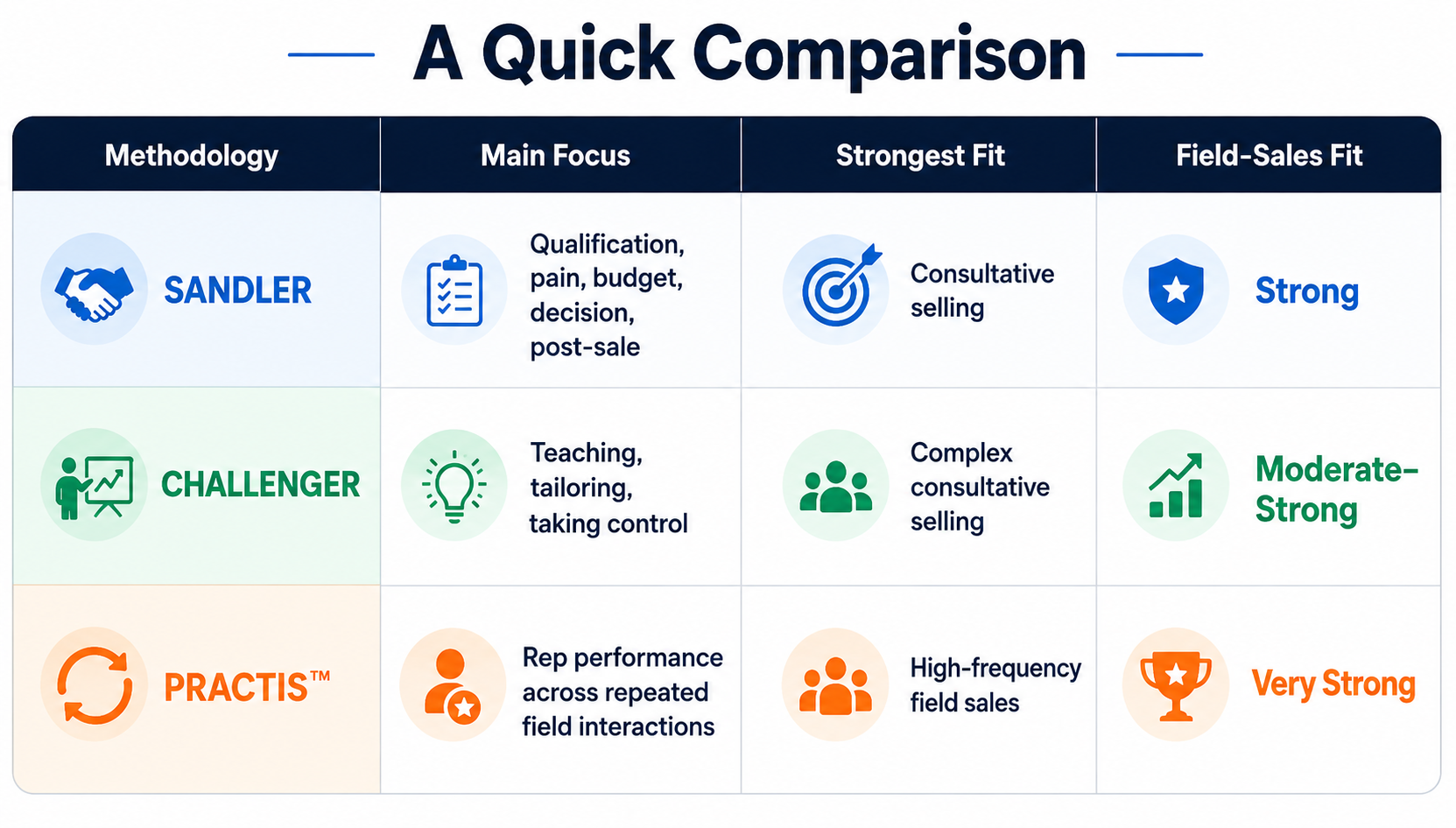
The important difference is what each methodology treats as the unit of analysis.
Sandler focuses heavily on the sales process and qualification. Challenger focuses on how the seller changes the buyer’s thinking and guides the sale. PRACTIS focuses on the performer across the entire field interaction cycle. The PRACTIS source explicitly describes this distinction and says it is intended to complement rather than replace established methodologies.
1. Sandler: Strong for Structured, Consultative Field Selling
Sandler is probably the most natural of the three for a salesperson who conducts longer, one-on-one consultations.
The official Sandler Selling System is built around seven stages:
- Bonding & Rapport
- Up-Front Contract
- Pain
- Budget
- Decision
- Fulfillment
- Post-Sell
That structure can work very well in home services.
Imagine an HVAC salesperson sitting with a homeowner.
Instead of immediately saying:
“We have a great 16-SEER system with a 10-year warranty.”
The salesperson first establishes what the homeowner is dealing with.
How old is the current system?
What problems have they experienced?
How often does it break down?
How does the problem affect comfort?
Have they already received other estimates?
What are they hoping to accomplish?
Then comes the financial conversation.
Sandler intentionally addresses budget before the solution presentation, helping both sides determine whether the opportunity is realistic.
Why Sandler works in home services
Home-service purchases often involve:
- A real problem
- A meaningful financial decision
- A homeowner who wants clarity
- Multiple possible solutions
- Potential buyer’s remorse
Sandler’s Pain → Budget → Decision sequence helps the salesperson avoid presenting a solution before understanding whether there is a genuine reason and ability to move forward.
The Post-Sell stage is particularly relevant to home services because the sale isn’t necessarily safe just because the contract is signed. Sandler specifically uses post-sale reinforcement to reduce buyer’s remorse and protect the commitment.
Where Sandler can struggle in high-frequency field sales
Here’s the catch.
Sandler can structure the conversation, but field sales often requires managing much more than the conversation.
Consider a door-to-door representative who has heard:
“Not interested.”
twenty times in a row.
The next homeowner opens the door.
The salesperson knows exactly what questions to ask.
But they’re tired.
Their confidence is down.
Their posture has changed.
They rush the introduction.
They avoid asking for the appointment.
The problem isn’t necessarily a lack of Sandler knowledge.
It’s performance under repetition.
That’s the gap PRACTIS is designed to address.
2. Challenger: Strong When the Salesperson Needs to Teach
Challenger takes a different approach.
Instead of simply asking the customer what they want, Challenger encourages the salesperson to bring insight that can change how the customer understands the problem.
Its core skills are:
- Teach
- Tailor
- Take Control
- Constructive Tension
That can be powerful in home services.
Consider a homeowner who says:
“I just want the cheapest roof repair.”
A salesperson using Challenger principles might discover something the homeowner hasn’t considered.
Maybe the visible leak isn’t the entire problem.
Maybe a repair addresses today’s symptom but not the underlying condition.
Maybe the homeowner is comparing bids based entirely on price without understanding differences in scope or materials.
The salesperson’s job is to educate—not simply agree.
That is the useful side of Challenger.
Challenger’s biggest strength in home services
It helps salespeople explain why the customer’s initial assumption may not tell the whole story.
That is valuable for:
- Roofing
- Solar
- HVAC
- Windows
- Insulation
- Home improvement
- Security
- Other technically complex services
Challenger describes its approach as helping customers think differently about their problems rather than simply pitching product value.
For example:
Instead of:
“Our windows are better.”
A salesperson might explain:“The reason you’re seeing condensation isn’t necessarily that the glass is simply old. Here’s what we’re seeing around the frame, and here’s how that affects the replacement options.”
Now the homeow
ner has learned something.
That’s much stronger than a feature dump.
But Challenger Needs Care in the Home
There is an important distinction between challenging the customer’s thinking and challenging the customer personally.
A homeowner sitting at their kitchen table is not the same as a corporate buying committee.
Too much pressure can quickly feel manipulative.
Challenger itself emphasizes that constructive tension is not simply aggression; it is intended to create productive movement by helping customers question the status quo.
That distinction is especially important in residential selling.
A salesperson can confidently say:
“Based on what we’ve found, I wouldn’t recommend the cheaper option because it doesn’t address the underlying issue.”
That’s professional.
But:
“If you don’t sign today, you’re making a huge mistake.”
is a very different conversation.
Home-service co
mpanies should be particularly careful with artificial urgency and misleading claims. The FTC warns consumers about high-pressure door-to-door selling and has federal rules covering certain sales made in the home.
So Challenger is useful in field sales—but it should be adapted with judgment.
3. PRACTIS: Built Around the Reality of Field Sales
This is where PRACTIS takes a different position.
The PRACTIS Method is described as a field-sales performance methodology for high-frequency, face-to-face selling. Its published framework uses seven stages:
Presence → Reveal → Agency → Clarify → Truth → Invite → Score
The loop is designed to operate before, during, and after every interaction, with the next interaction beginning from what was learned in the previous one.
That matters because field sales has a unique problem:
The salesperson has to perform again and again.
Not just once.
Presence: The Part Most Sales Training Ignores
Imagine a salesperson gets rejected at the previous house.
They walk to the next door.
If they carry that rejection with them, the next interaction may already be compromised.
Their voice is different.
Their energy is lower.
They want the conversation over quickly.
They may stop asking good questions.
Or they may become too aggressive because they are trying to “make up” for the previous rejection.
PRACTIS begins with Presence because the next interaction starts before the first words are spoken.
The framework’s thesis is that field performance depends on what a representative can consistently do at the fourth door and the thirty-ninth door—not merely what they know.
That is a very different training problem from teaching a salesperson a better question.
Reveal: Don’t Make the Homeowner Guess Why You’re There
A field salesperson has another challenge:
The customer may be suspicious before the conversation even begins.
PRACTIS therefore emphasizes transparency around who the representative is, why they are there, and what they are asking for.
This is especially relevant in door-to-door selling.
The homeowner should not have to spend five minutes trying to figure out whether the salesperson is actually selling something.
Clear communication reduces uncertainty.
And in residential selling, reducing uncertainty is often the first step toward earning trust.
Agency: Give the Buyer Real Control
This is another important PRACTIS principle.
The homeowner should have meaningful control over whether the interaction continues.
That doesn’t mean the salesperson becomes passive.
It means the salesperson can be confident without pretending the customer has no choice.
That distinction is important in the U.S. home-services market.
The FTC’s consumer guidance notes that certain qualifying home sales have a three-business-day cancellation period under the Cooling-Off Rule, while also listing important exemptions.
So a good field-sales process should not depend on preventing the customer from thinking, comparing, or changing their mind.
A strong sale should survive an informed customer.
Clarify: This Is Where Sandler and PRACTIS Work Together
PRACTIS is not designed to eliminate traditional sales skills.
In fact, this is where the frameworks can work together.
PRACTIS provides the interaction structure.
Sandler provides powerful discovery and qualification techniques.
For example:
PRACTIS — Clarify
Sandler — PainUnderstand the homeowner’s actual problem.
Then:
Sandler — Budget
Understand whether the investment makes sense.
Then:
Sandler — Decision
Understand how the homeowner intends to decide.
PRACTIS itself describes this kind of composition rather than positioning the framework as a replacement for Sandler.
Truth: Where Challenger Can Fit Inside PRACTIS
The same thing can happen with Challenger.
PRACTIS’s Truth stage asks the salesperson to communicate accurate, relevant, specific, and verifiable information.
That creates a natural place for Challenger-style commercial insight.
For example:
A homeowner says:
“I only care about the cheapest option.”
The salesperson might explain:
“That’s completely reasonable. Before you compare prices, though, let me show you why these two estimates aren’t actually covering the same scope of work.”
That’s a teaching moment.
The salesperson is not simply agreeing with the homeowner.
They’re helping the homeowner make a better comparison.
So:
PRACTIS provides the performance environment.
Challenger provides a useful way to educate and reframe.
That is a much more practical relationship between the methodologies than trying to choose only one.
Invite: The Salesperson Still Has to Ask
One of the most common weaknesses in field sales is the salesperson who does everything except ask.
They:
- build rapport,
- inspect the property,
- explain the product,
- answer questions,
- demonstrate value,
- discuss price…
Then:
“So, what do you think?”
PRACTIS calls for a clear Invite.
The salesperson
should make an appropriate recommendation and ask the customer whether they want to move forward.
That doesn’t mean forcing a yes.
It means being willing to ask.
This connects with Challenger’s Take Control concept and Sandler’s emphasis on establishing clear commitments and decision processes.
Score: The Difference Between Repeating and Learning
This may be the most important distinction for field sales teams.
A salesperson finishes an interaction.
The customer says no.
What happens next?
In many organizations:
Nothing.
The salesperson walks to the next house.
Tomorrow, they make the same mistake.
Next week, they make it again.
PRACTIS adds Score to the interaction so the salesperson can record what happened and identify what to improve.
The methodology describes performance as observable and coachable across nine dimensions, including:
- Inner Game
- Human
- Trust
- Information
- Tactical
- Competitive
- Score
- Learning
- Long Game
This changes the manager’s coaching conversation.
Instead of:
“You need to close harder.”
A manager can ask:
“Why didn’t you ask?”
Was it:
- lack of confidence?
- poor timing?
- weak discovery?
- lack of trust?
- incomplete information?
- fear of rejection?
Those are different problems.
They require different coaching.
Sandler vs. Challenger vs. PRACTIS: The Real Difference
Here’s the simplest way to understand the three:
Sandler asks:
“Are we having the right sales conversation, with the right qualification and commitment?”
Challenger asks:
“Are we teaching the customer something valuable and helping them rethink the status quo?”
PRACTIS asks:
“Can the salesperson consistently perform well before, during, and after every field interaction?”
Those are three different questions.
And a strong field-sales organization can benefit from all three.
Which One Fits Door-to-Door Sales Best?
If we’re talking specifically about high-frequency door-to-door sales, PRACTIS has the most direct environmental fit.
Why?
Because its framework explicitly addresses:
- repeated short interactions,
- emotional variability,
- rejection recovery,
- buyer autonomy,
- field behavior,
- coaching,
- learning between interactions,
- and long-term territory value.
Traditional conversation methodologies can teach a salesperson what to say.
But a field salesperson also needs to know how to show up at door #39 after door #38 went badly.
That’s the problem PRACTIS is trying to solve.
Which One Fits In-Home Consultative Selling Best?
The answer becomes more balanced when the sales process is a scheduled, longer in-home appointment.
For example:
A homeowner schedules an HVAC consultation.
The salesperson has 60–90 minutes.
They inspect the system.
They sit down with the homeowner.
They discuss the problem.
They review options.
They discuss investment.
They make a recommendation.
Here, Sandler can be extremely useful.
Its structured approach to pain, budget, decision, fulfillment, and post-sale fits naturally into a longer consultation.
PRACTIS can still provide the broader performance layer around that conversation.
Which One Fits Complex or Technical Selling Best?
If the salesperson needs to change the customer’s understanding of the problem, Challenger becomes especially useful.
For example:
- explaining why the cheapest HVAC system isn’t necessarily the lowest-cost option,
- showing why a roofing estimate isn’t comparable simply because both quotes say “roof replacement,”
- explaining the economics of solar,
- helping a homeowner understand a long-term energy or maintenance decision.
The salesperson isn’t merely responding to customer questions.
They’re bringing expertise.
That’s where Challenger shines.
The Best Answer May Be: Use Them Together
This is the key point.
The methodologies don’t have to compete.
A practical field-sales system could look like this:
Before the interaction
PRACTIS – Presence
Get mentally ready. Reset from the previous interaction.
Opening
PRACTIS – Reveal + Agency
Be clear about who you are, why you’re there, and give the homeowner control over whether to continue.
Discovery
PRACTIS – Clarify + Sandler
Understand pain, consequences, budget considerations, and decision factors.
Education
PRACTIS – Truth + Challenger
Use accurate information and relevant insight to help the homeowner understand their options.
Decision
PRACTIS – Invite + Sandler
Make a recommendation, ask for the decision, and clarify next steps.
Afterward
PRACTIS – Score
Record the outcome, identify the lesson, and prepare for the next interaction.
That is not a mash-up for the sake of having three sales methodologies.
It is a practical division of labor.
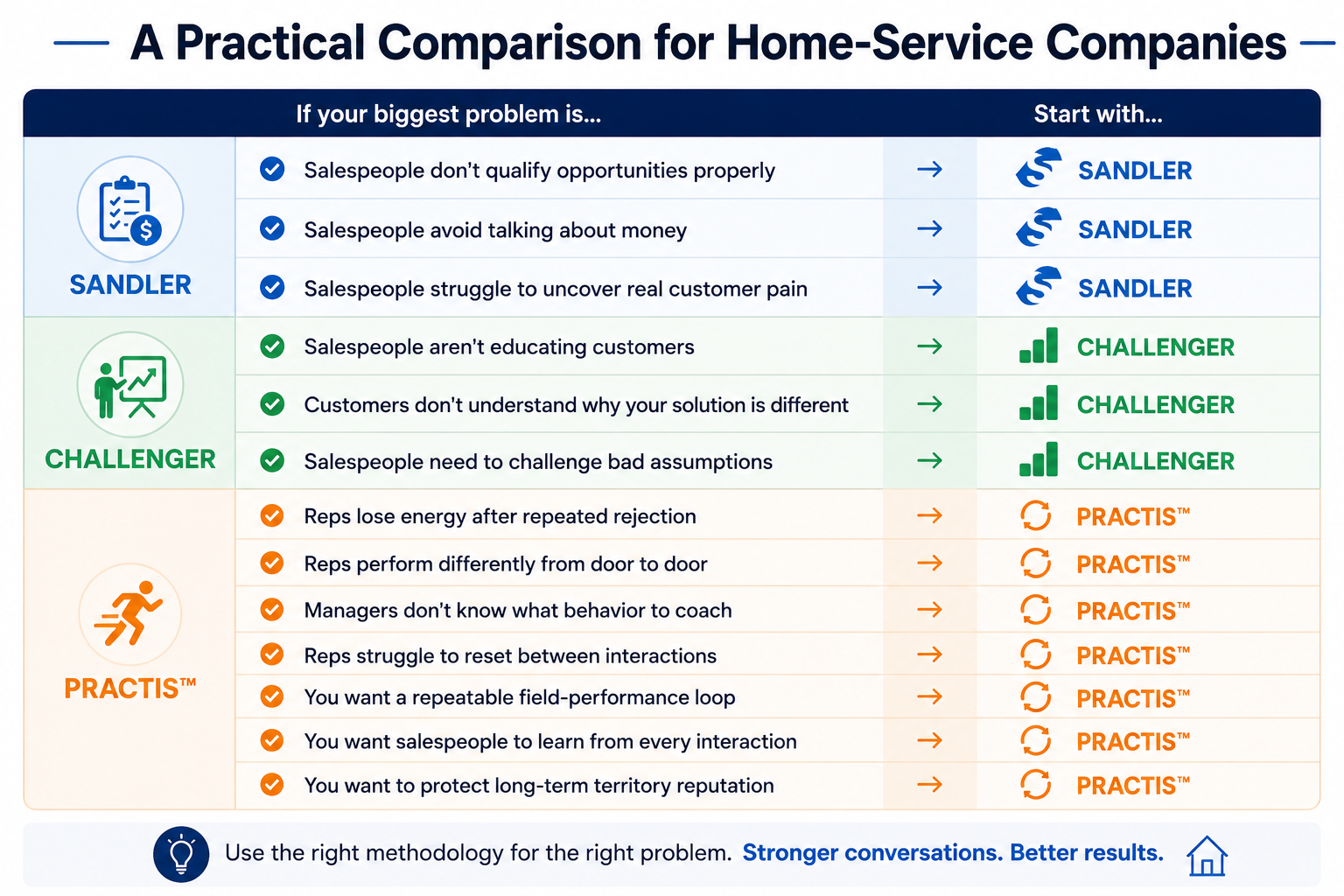
One Important Caveat About PRACTIS
For an article aimed at a sophisticated U.S. business audience, it is important not to overstate the evidence.
The PRACTIS source describes the methodology as a structured, evidence-oriented framework entering field validation. Its outcome claims are described as hypotheses to be tested through instrumented pilots, field observation, manager calibration, and behavioral data.
That means it would be misleading to write:
“PRACTIS has been scientifically proven to outperform Sandler and Challenger.”
The available material does not establish that.
A more accurate statement is:
PRACTIS is specifically designed around the operating realities of high-frequency field sales, while Sandler and Challenger offer established sales-process and conversation principles that can complement it.
That’s a stronger and more credible argument.