Best Sales Methodologies for Home Services and In-Home Selling
Selling a home service is different from selling software, office equipment, or a traditional retail product.
The customer may be standing in their kitchen while a salesperson explains a new roof. They may be sitting at the dining-room table comparing HVAC options, considering pest control, asking about solar, or trying to decide whether a home improvement project is actually necessary.
There is no conference room. There may be no formal buying committee. And the customer did not necessarily wake up that morning expecting to have a sales conversation.
That changes everything.
For home-service companies in the United States, the best sales methodology is not simply the one with the most famous name. It is the one that helps a representative earn attention, understand the homeowner’s actual problem, explain the solution honestly, ask for the business confidently, and leave the relationship stronger than it was before the visit.
Several established sales methodologies can help. SPIN Selling provides a powerful discovery structure. Sandler brings useful discipline around qualification, expectations, and post-sale commitment. Challenger can help representatives educate homeowners when an important misconception needs to be corrected. MEDDPICC can be useful when a home-service sale becomes a more complex commercial opportunity.
But for high-frequency, face-to-face selling—particularly door-to-door and territory-based home services—there is another problem that these conversation-centered frameworks do not fully address:
How does the salesperson perform consistently across dozens of emotionally different interactions every day?
That is the problem the PRACTIS Method is designed to address.
The methodology describes a seven-stage interaction loop—Presence, Reveal, Agency, Clarify, Truth, Invite, and Score—supported by nine observable performance dimensions. Its stated focus is high-frequency field sales in industries such as roofing, solar, pest control, home security, telecom, home improvement, and insurance.
The most useful way to think about these methodologies is not as competitors fighting for one winner.
It is as different tools solving different problems.
What Makes Home-Service Sales Different?
A typical home-service sale has three characteristics that make it unusually demanding.
1. The salesperson enters the customer’s personal space
A homeowner’s house is not a neutral business environment.
When someone arrives at the door, the homeowner may immediately wonder:
- Who are you?
- Why are you here?
- How long will this take?
- Are you actually from the company you claim to represent?
- Is this really necessary?
- Am I being pressured into something?
- Can I trust what you’re telling me?
- What happens if I say no?
That initial skepticism is understandable.
The FTC’s consumer guidance specifically warns that high-pressure door-to-door selling can contribute to buyer’s remorse and explains federal protections that may apply to certain sales made in a consumer’s home.
That means trust is not merely a “soft skill” in home services.
Trust is part of the sales infrastructure.
2. The purchase can be emotionally significant
A homeowner may spend thousands of dollars on a roof, HVAC system, solar installation, windows, insulation, or another major improvement.
Even when the financial value is manageable, the decision can feel personal.
The customer is not simply asking:
“Does this product have the right features?”
They may really be asking:
“Do I need this?”
“Can I trust this company?”
“Is this salesperson telling me the whole story?”
Will the work actually be done correctly?
“Will I regret this tomorrow?”
That makes discovery, clarity, transparency, and expectation-setting extremely important.
3. The salesperson may repeat the process dozens of times
A home-service field representative may have one conversation that goes brilliantly and another ten minutes later with a completely different homeowner.
One person may be friendly.
The next may be suspicious.
The next may be angry about another company.
The next may be interested but distracted.
The next may simply say, “No thanks.”
This is why the attached PRACTIS methodology makes an important distinction: field sales is not one long conversation. It is a long day of short ones.
And that leads to the central question:
What methodology helps the salesperson perform well at interaction #30—not just interaction #1?
The Best Sales Methodologies for Home Services
There is no universal winner. The strongest home-service sales organizations can borrow different strengths from several methodologies.
Here are the most useful ones to understand.
1. PRACTIS™ Best Fit for High-Frequency Field and In-Home Performance
PRACTIS is different from traditional conversation methodologies because its primary unit of analysis is not simply the conversation or the deal.
It is the performer.
The methodology is built around seven stages:
- Presence
- Reveal
- Agency
- Clarify
- Truth
- Invite
- Score
The loop is designed to operate before, during, and after every interaction, with the final stage feeding the next interaction.
Presence: Reset before the conversation
A salesperson who just heard “Get off my property” cannot simply walk to the next house and pretend nothing happened.
The rejection affects posture, voice, energy, confidence, and willingness to ask.
PRACTIS calls for a deliberate reset.
The idea is simple:
The previous homeowner should not control the next conversation.
This is particularly relevant in door-to-door sales because rejection happens repeatedly and quickly.
Reveal: Be transparent immediately
The salesperson clearly communicates:
- who they are,
- what company they represent,
- why they are there,
- what they are asking for,
- and how much time the homeowner can expect to spend.
The attached methodology describes honesty as a pattern-break because homeowners often expect salespeople to be evasive.
This principle is especially powerful in residential selling.
A homeowner should not have to spend five minutes figuring out whether the person at the door is actually trying to sell something.
Agency: Give the homeowner genuine control
Agency means the homeowner has meaningful choices.
They can decide whether to continue.
They can decide how much time to spend.
They can decide what they want to discuss.
And, importantly, they can say no.
PRACTIS treats buyer control as a performance requirement rather than a courtesy.
That matters because a salesperson can technically “close” someone while still creating a terrible customer experience.
Clarify: Find the real problem
This is where PRACTIS overlaps naturally with consultative selling.
A homeowner might say:
“I need a new roof.”
But that may not actually be the problem.
Perhaps there is a recurring leak.
Perhaps an inspection identified an issue.
Perhaps the homeowner is preparing to sell.
Perhaps they are worried about storm damage.
Perhaps they simply want to understand whether replacement is necessary.
Good discovery moves from the symptom to the root problem and then to the consequence.
That closely aligns with the logic behind SPIN Selling.
Truth: Make the case verifiable
The Truth stage asks the salesperson to present information that is:
- relevant,
- accurate,
- specific,
- and checkable.
It also calls for straightforward discussion of price and limitations rather than hiding inconvenient information.
This is particularly important in home services because technical claims can have real financial consequences.
If a salesperson tells a homeowner that something “must” be replaced, that statement should be supportable.
If a repair may be sufficient, that possibility should not be hidden simply because a replacement has a higher ticket.
Invite: Actually ask for the business
Many salespeople become uncomfortable at this point.
They explain everything.
They answer every question.
They build value.
Then they say:
“So… what do you think?”
A strong methodology does not require awkwardness at the moment of decision.
PRACTIS calls for a clear and appropriate ask, honest options, and enough silence for the buyer to make a genuine decision.
Score: Learn from the interaction
This may be the most distinctive element.
The interaction does not simply end when the customer says yes or no.
The salesperson records the outcome, captures commitments, identifies what worked, identifies one adjustment, and carries that lesson into the next interaction.
In other words:
Every interaction becomes training for the next one.
That is particularly suited to high-volume field sales.
2. SPIN Selling Best for Discovery and Problem Understanding
SPIN Selling is one of the most established consultative sales methodologies.
Its four question types are:
- Situation
- Problem
- Implication
- Need-Payoff
Huthwaite describes SPIN as a research-based methodology developed from extensive observation of real sales calls.
For home services, the framework is useful because homeowners often begin with a surface-level complaint.
Imagine an HVAC conversation.
Situation:
“How old is the current system?”
Problem:
“What problems have you been noticing?”
Implication:
“What happens when the system goes down during the summer?”
Need-payoff:
“If you could have a system that reduced those breakdowns and made the monthly energy costs more predictable, how important would that be?”
The strength of SPIN is that it prevents the salesperson from rushing into a product presentation.
Instead of saying:
“Here’s our premium HVAC system.”
The salesperson first understands why the homeowner might need it.
For roofing, pest control, windows, insulation, solar, and other home services, this can be extremely valuable.
Where SPIN can fall short in field sales
SPIN is primarily a conversation framework.
It does not by itself solve the emotional reset after rejection, the consistency problem across dozens of doors, or the question of how a manager observes and diagnoses behavior between interactions.
That is where the PRACTIS framework can complement it.
The attached methodology specifically suggests using SPIN-style questioning inside Clarify.
3. Sandler — Best for Qualification, Expectations, and Post-Sale Discipline
Sandler is especially useful for sales organizations that struggle with qualification, unclear expectations, or buyer’s remorse.
Its system includes:
- Bonding and rapport
- Up-front contract
- Pain
- Budget
- Decision
- Fulfillment
- Post-sell
Sandler itself describes the approach as consultative and low-pressure, with emphasis on understanding pain, budget, decision processes, and post-sale issues.
That translates surprisingly well to home services.
Before spending an hour measuring a house, reviewing options, and preparing a proposal, the salesperson should understand what the homeowner actually wants to accomplish.
And after the sale, the work is not finished.
Home-service companies know this painfully well.
A customer who signs today can become unhappy tomorrow if:
- expectations were unclear,
- installation timing was misunderstood,
- the price was misunderstood,
- financing terms were misunderstood,
- the scope of work was unclear,
- or the homeowner feels they were pressured.
Sandler’s emphasis on post-sale reinforcement is therefore particularly relevant.
The home-service lesson from Sandler
A sale is not truly successful if the customer immediately wishes they had not made it.
This idea fits closely with PRACTIS’s emphasis on expectation management, trust, and the Long Game dimension.
4. Challenger Best When the Customer Needs a New Perspective
Challenger selling is built around:
- Teach
- Tailor
- Take Control
- Constructive Tension
The methodology emphasizes bringing commercial insight that changes how the customer thinks about a problem rather than simply asking the customer what they want.
This can be useful in home services when homeowners have a misconception.
For example, a homeowner might say:
“I just want the cheapest roof repair.”
A knowledgeable salesperson may discover that the cheaper repair does not address the underlying issue.
The salesperson’s job is not to scare the homeowner into buying.
It is to explain:
- what they observed,
- what it may mean,
- what can and cannot be confirmed,
- what the options are,
- and what could happen if the problem is ignored.
That’s constructive education rather than pressure.
The danger of using Challenger badly
“Take control” can easily be misunderstood.
In a homeowner’s living room, aggressive control is likely to damage trust.
Challenger itself distinguishes taking control from simply being aggressive and describes the approach as guiding the commercial conversation rather than attacking the customer.
For home services, the better interpretation is:
Be confident enough to recommend. Be respectful enough to let the homeowner decide.
That distinction is crucial.
5. MEDDPICC — Best for Complex, Higher-Value Commercial Opportunities
MEDDPICC is primarily an opportunity-qualification framework.
Its elements include:
- Metrics
- Economic Buyer
- Decision Criteria
- Decision Process
- Paper Process
- Identify Pain
- Champion
- Competition
For a straightforward residential pest-control sale, MEDDPICC is probably more machinery than you need.
But home-service organizations can have more complex commercial sales:
- multifamily housing,
- property management,
- large roofing contracts,
- commercial HVAC,
- facilities services,
- insurance-related work,
- large-scale solar,
- institutional accounts.
In those environments, understanding who makes the decision, what criteria matter, how the contract gets approved, and what alternatives exist can be extremely useful.
MEDDPICC is therefore best viewed as a qualification layer, not necessarily the core methodology for every residential door.
The PRACTIS source makes essentially the same distinction: MEDDIC-style qualification can operate alongside the field interaction when the field sale feeds a longer commercial process.
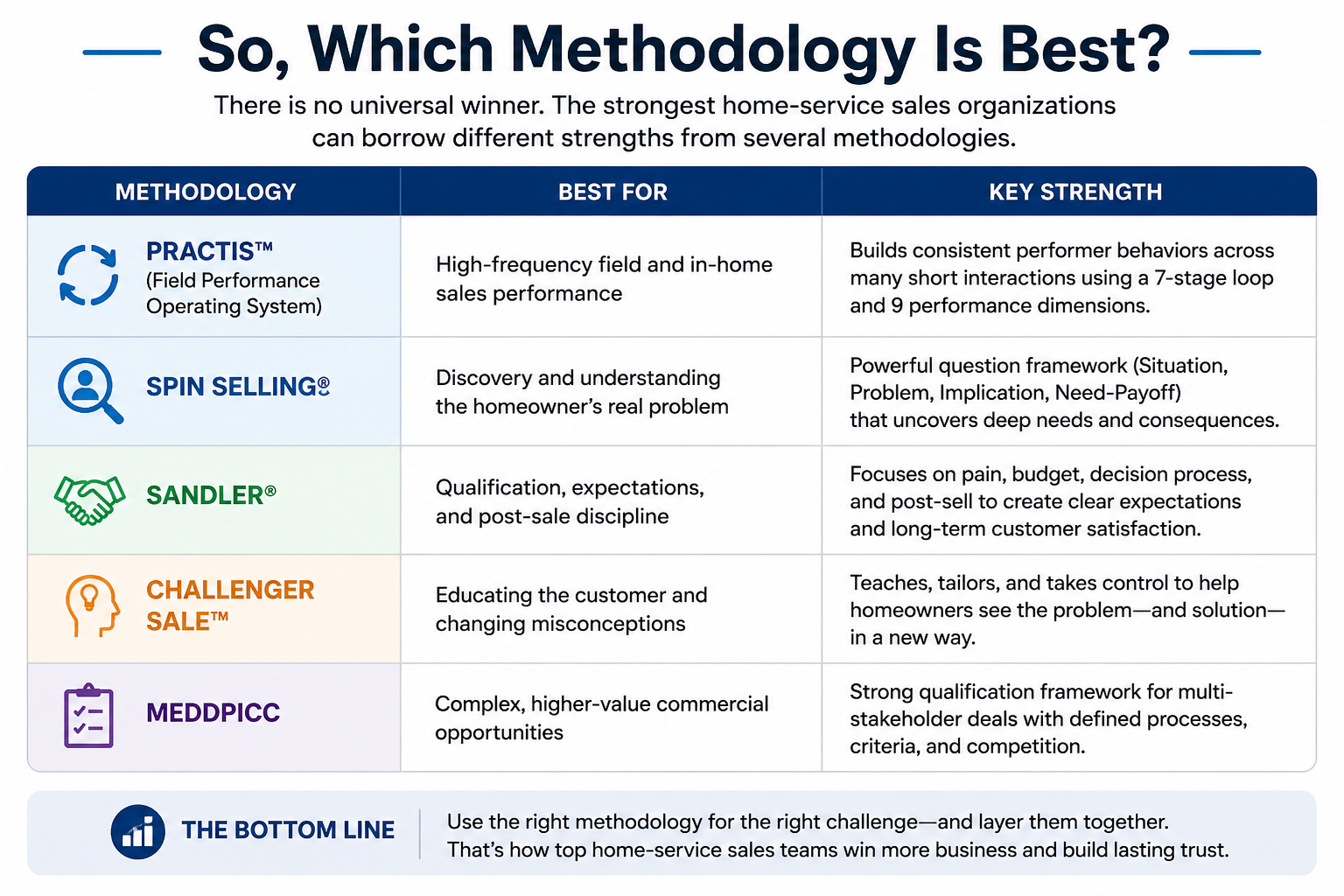
The important insight is that these frameworks operate at different levels.
SPIN structures questions.
Sandler structures the sales process and qualification.
Challenger structures commercial insight and control.
MEDDPICC structures opportunity qualification.
PRACTIS structures the performer across repeated field interactions.
The attached methodology explicitly positions PRACTIS as complementary rather than a replacement for SPIN, Sandler, Challenger, or MEDDIC.
The Nine Skills Home-Service Salespeople Need
One of the strongest ideas in the PRACTIS framework is the distinction between stages and performance dimensions.
The seven stages describe where the salesperson is in the interaction.
The nine dimensions describe what the salesperson needs to be capable of throughout the interaction.
Those dimensions are:
1. Inner Game
Emotional regulation, readiness, resilience, and recovery.
For field sales, this matters because rejection is not an occasional event.
It is part of the job.
2. Human
Can the salesperson read the person standing in front of them?
A homeowner who is rushing to pick up their child should not receive the same interaction as someone who has been researching solar for six months.
3. Trust
Transparency, buyer control, integrity, and expectation management.
4. Information
Can the salesperson gather and communicate accurate, relevant, specific information?
5. Tactical
Can they choose the right move at the right moment?
Sometimes the right move is to ask another question.
Sometimes it is to stop talking.
Sometimes it is to make the recommendation.
Sometimes it is to leave.
6. Competitive
Can the salesperson confidently ask for business without becoming pushy?
This distinction matters.
Confidence and pressure are not the same thing.
7. Score
Can the salesperson accurately record what actually happened?
8. Learning
Can the salesperson turn one interaction into one improvement?
9. Long Game
Does the salesperson protect the company’s reputation, referrals, relationships, and ability to work the territory again?
The source describes these nine dimensions as the qualities a coach can observe, diagnose, and develop.
Why the “Long Game” Matters in Home Services
This deserves special attention.
A home-service company does not operate in a vacuum.
The same neighborhoods may be visited again.
The same homeowner may recommend a company to a neighbor.
A bad experience can travel through a neighborhood just as quickly as a good one.
That means the salesperson is not merely trying to maximize today’s close rate.
They are also creating tomorrow’s:
- referrals,
- reviews,
- repeat business,
- neighborhood reputation,
- and permission to return.
The PRACTIS framework calls this Long Game and treats territory value as an explicit performance dimension.
This is a particularly sensible principle for residential selling.
A salesperson who closes one additional job by using deceptive urgency may appear successful on today’s dashboard.
But if the homeowner cancels, complains, posts a negative review, or warns the neighbors, the apparent win becomes much less valuable.
Ethics Are Not Separate From Sales Performance
For home-service selling, ethical behavior is not just a compliance issue.
It is part of the customer experience.
The PRACTIS framework makes transparency, buyer autonomy, verifiable claims, and a genuine right to say no central to its approach.
That approach also aligns with the practical reality of U.S. consumer protection.
The FTC’s Cooling-Off Rule covers certain sales made at a consumer’s home and, when applicable, gives consumers three business days to cancel. The rule has important exceptions, so companies should not assume that every home-service transaction is covered in exactly the same way.
Home-service companies also need to pay attention to state and local requirements, licensing rules, contract requirements, solicitation rules, and industry-specific regulations.
The broader sales lesson is simple:
Don’t build a sales process that depends on the customer not understanding what they bought.
A good methodology should make the sale easier to understand, not harder.
What a Great In-Home Sales Conversation Actually Looks Like
Consider a homeowner who is evaluating a roof replacement.
A weak sales process might look like this:
“We’ve been roofing in the area for 20 years. We’re a five-star company. We use premium materials. Here’s our warranty.”
The salesperson may be saying perfectly reasonable things.
But they have not established why the homeowner should care.
A stronger interaction could follow this progression:
Presence
The salesperson resets before entering the interaction rather than carrying the previous rejection into the next home.
Reveal
They clearly explain who they are, why they are there, and what they are asking from the homeowner.
Agency
They establish that the homeowner can decide whether to continue.
Clarify
They investigate what the homeowner has noticed, what has already been tried, what concerns them, and what outcome they want.
Truth
They explain what they can verify, what they cannot yet verify, the available options, the price, and the limitations.
Invite
They make a direct recommendation and ask whether the homeowner wants to move forward.
Score
They document the decision, set expectations, and capture the lesson from the interaction.
This is not a script.
That distinction matters.
The PRACTIS material explicitly says that its purpose is to define performance rather than prescribe word-for-word dialogue.
The salesperson still needs to sound like a human being.
The Biggest Mistake: Turning a Methodology Into a Script
This is where many sales programs go wrong.
A homeowner says:
“We’re not interested.”
The salesperson remembers the training manual and immediately produces the approved rebuttal.
The homeowner hears the script.
The salesperson hears the script.
Nobody feels like they are having a real conversation.
A methodology should provide structure without removing judgment.
The PRACTIS approach makes this explicit: it is not intended to be a word-for-word script. It defines what the interaction needs to accomplish and what good performance looks like, while allowing the representative to adapt to the actual person in front of them.
That’s an important distinction for home services.
Every house is different.
Every homeowner is different.
Every problem is different.
The methodology should create consistency in quality, not sameness in language.
How Home-Service Managers Should Coach Their Sales Teams
Traditional sales coaching often sounds like:
“You need to close better.”
That’s not particularly useful.
A better coaching question is:
What actually caused the weak close?
The PRACTIS framework gives an interesting diagnostic model.
Suppose five salespeople all have a weak “close.”
They may appear to have the same problem.
But the underlying issues could be completely different.
One salesperson is afraid to ask.
That’s a Competitive problem.
Another asks confidently but never uncovered the homeowner’s real problem.
That’s an Information problem.
Another asks too early.
That’s a Tactical problem.
Another creates artificial urgency.
That’s a Trust problem.
Another gets the sale but fails to set expectations, leading to buyer’s remorse.
That may involve Trust and Score.
The source makes this distinction directly: the same visible failure can have different underlying causes, requiring different coaching.
That’s much more useful than telling everyone to “work on their closing.”
The Best Home-Service Sales System Is a Stack
Rather than searching for one magic methodology, home-service companies should think in layers.
Layer 1: Field-performance operating system
Use PRACTIS-style principles to develop the salesperson’s ability to perform consistently before, during, and after repeated interactions.
Layer 2: Discovery
Use SPIN-style questioning to move beyond symptoms and understand problems, consequences, and desired outcomes.
Layer 3: Qualification
Use appropriate Sandler principles to establish expectations, understand pain, budget, decision factors, and post-sale concerns.
Layer 4: Education
Use Challenger-style thinking when the homeowner needs a credible new perspective or when the salesperson needs to challenge an inaccurate assumption.
Layer 5: Complex qualification
Use MEDDPICC selectively for larger commercial or multi-stakeholder opportunities.
Layer 6: Measurement and coaching
Track not just revenue, but observable behaviors, customer outcomes, cancellations, follow-through, referrals, and learning.
This creates something much more useful than a sales script.
It creates a sales operating system.
What Should Home-Service Companies Measure?
Revenue still matters.
Close rate still matters.
Average ticket still matters.
But they should not be the only measurements.
A mature home-service sales organization should also consider:
- appointment-to-sale conversion,
- inspection-to-proposal conversion,
- proposal-to-close conversion,
- cancellation rate,
- financing fallout,
- customer complaints,
- referral rate,
- review quality,
- follow-up completion,
- expectation-setting accuracy,
- permission-to-continue,
- quality of discovery,
- accuracy of claims,
- and observable sales behaviors.
PRACTIS specifically describes measuring observable behavior against its nine dimensions alongside outcomes such as permission to continue, clarity of next steps, and post-sale durability.
That is an important shift:
Measure not only what happened, but how it happened.