AI roleplay has moved from an interesting sales-training experiment to a serious category of sales technology.
A few years ago, if you wanted a rep to practice a cold call, discovery conversation, or tough objection, there were basically two choices: have a manager play the buyer or let the rep practice with another salesperson.
Neither option scales particularly well.
Managers are busy. Reps often don’t want to look bad in front of their boss. And a roleplay scheduled once a month isn’t enough repetition to change behavior.
AI changes that equation.
Today, sales reps can practice conversations with AI buyers on demand, repeat difficult scenarios, receive immediate feedback, and work through objections without putting a real prospect or customer at risk.
But there’s a catch.
Not every AI roleplay platform is solving the same problem.
Some are built primarily for cold-call practice. Others focus on enterprise sales enablement. Some are strongest for presentation and communication coaching. Others are designed around highly regulated industries or certification.
And for sales leaders, the most important question isn’t necessarily:
“Which platform has the most realistic AI buyer?”
It’s:
“How do I know my reps are actually ready before I put them in front of a real buyer?”
That distinction matters more in 2026 than it did even a year ago.
Below is a closer look at the leading AI roleplay platforms for sales teams, what each does well, where each fits, and what buyers should look for before signing a contract.
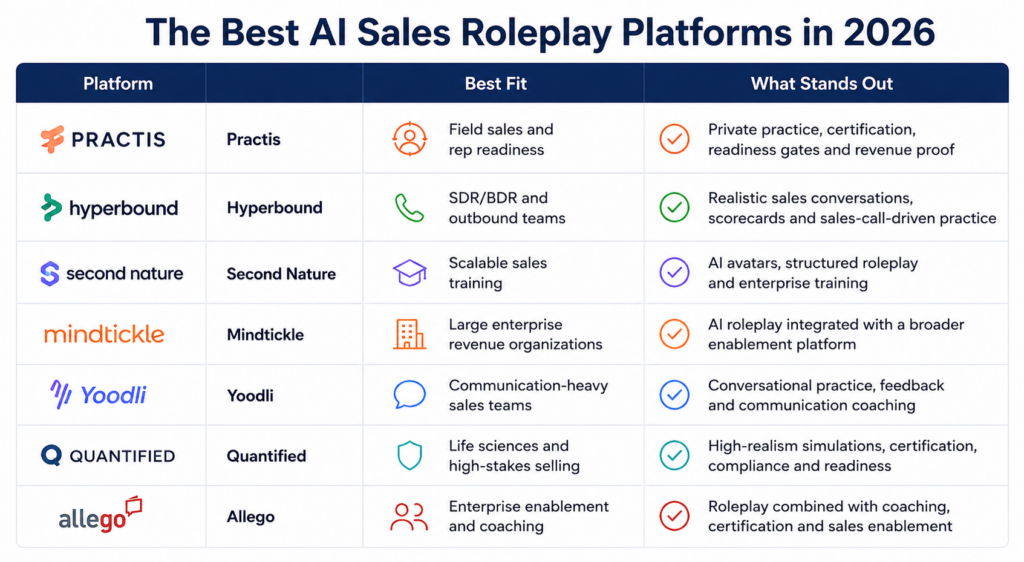
The “best” platform depends heavily on what your organization is actually trying to fix.
If your problem is cold-call confidence, one tool may make more sense.
If you’re onboarding 500 enterprise sellers across multiple regions, the answer may be completely different.
And if you’re running a field-sales organization where an unprepared rep can burn a paid lead at the customer’s kitchen table, you should probably evaluate these platforms through a different lens altogether.
1. Practis: Best for Field Sales Readiness
Practis takes a slightly different approach to the AI roleplay category. Instead of treating roleplay as the product, Practis positions it as part of a larger sales-readiness system. The idea is simple: practicing a conversation is useful, but practice alone doesn’t tell a sales leader whether someone is ready to sell. Practis combines AI practice with certification and readiness measurement. Reps can practice conversations against their company’s playbook and selling methodology, then complete certification against defined standards before going live. That makes Practis particularly interesting for field-sales organizations. Think pest control, lawn care, remodeling, solar, home services, home security and other businesses where reps are physically meeting customers and where a bad first conversation can have an immediate financial cost. The company’s positioning document makes this distinction even more explicit: the problem isn’t simply that reps need more training. The problem is that operators often don’t know who is ready before they spend money sending that rep to a lead. What makes Practis different? The strongest differentiator is the separation between practice and certification. Practice is designed to be private, allowing reps to make mistakes without feeling like every attempt is being reported to management. Certification is different. It is structured, scheduled and measured against a defined standard. That creates an important psychological distinction: Practice is where you fail safely. Certification is where you prove you can perform. Practis also emphasizes the idea of a published certification standard rather than an opaque score generated by a vendor. Its current product materials describe AI-scored roleplay, certification gates, objective scoring and recertification. Best for:- Field-sales organizations
- High-volume hiring environments
- New-hire ramp
- Teams without large enablement departments
- Organizations that need a readiness gate before live selling
- Operators who want training tied to business outcomes
2. Hyperbound: Best for SDR and Outbound Practice
Hyperbound is one of the better-known names in the AI sales-roleplay space, particularly for outbound sales. Its roleplay library covers cold calls, gatekeeper calls, voicemails, warm calls, discovery, demos, renewals, upsells and other sales situations. It also provides AI scorecards and immediate coaching. The platform’s approach is heavily centered on making practice feel closer to an actual sales conversation. That’s particularly useful for SDR and BDR teams. Cold calling is a perfect example. A rep can know the script and still freeze when a prospect says: “I’m busy.” Or: “Just send me an email.” Or: “We already have someone for that.” AI roleplay gives reps somewhere to encounter those moments repeatedly before they’re dealing with a real prospect. Hyperbound also emphasizes connecting insights from real sales conversations to targeted practice, rather than treating roleplay as a completely separate training activity. Best for- SDR and BDR teams
- Outbound prospecting
- Cold-call practice
- Objection handling
- Sales organizations looking for gamified practice
- Teams that already have sales-call data they can use to improve training
3. Second Nature: Best for Scalable AI Sales Training
Second Nature has been in the AI roleplay category for years and takes a broader training-oriented approach. The platform lets reps practice scenarios such as discovery calls, objection handling, product demonstrations and cold calls with AI personas. It also supports customized roleplays and integrations with LMS, CRM and other enterprise systems. One of its biggest strengths is accessibility. Sales organizations can create structured training experiences without asking managers to personally roleplay with every rep. That matters when a company is onboarding dozens or hundreds of sellers at once. Second Nature also combines AI roleplay with more traditional learning content, which can make it a natural fit for organizations that want training content and practice to live in the same ecosystem. Best for- Enterprise sales training
- Large-scale onboarding
- Organizations already using an LMS
- Structured sales curricula
- Teams that want AI practice alongside traditional training material
4. Mindtickle: Best for Enterprise Revenue Enablement
Mindtickle is a different type of competitor because AI roleplay sits inside a much broader revenue-enablement platform. Its AI Sales Role Play product is designed around dynamic selling scenarios, immediate feedback and scalable evaluation. The company says teams can use AI to create roleplays, grade submissions and support different sales motions. That becomes especially attractive for large organizations that don’t want another standalone training application. Mindtickle’s broader platform includes sales training, content management and performance insights, so roleplay can sit alongside the rest of a revenue-enablement program. The platform also supports scenarios such as objection handling, negotiations, renewals, product launches and other sales situations. Best for- Large enterprise sales organizations
- Revenue enablement teams
- Organizations with complex sales motions
- Companies wanting training, content and roleplay in one platform
- Teams already investing heavily in enablement infrastructure
5. Yoodli: Best for Communication and Conversation Coaching
Yoodli comes from a somewhat different starting point. Its platform is focused heavily on communication and spoken interaction, and it has expanded into sales-specific AI roleplay. Sales teams can use it to practice discovery calls, objections, demos and other conversations, with immediate feedback after the interaction. That makes Yoodli particularly interesting for organizations where communication quality matters as much as sales-process adherence. A rep can have the right information and still sound uncertain. They can talk too much. They can rush. They can fail to ask a follow-up question. They can lose control of the conversation. Those are behavioral problems, not knowledge problems. Yoodli is well suited to that layer. Best for- Communication-heavy sales environments
- Presentation and conversation skills
- Sales enablement teams
- Organizations that want scalable spoken practice
- Teams that care about how reps communicate, not just what they say
6. Quantified: Best for High-Stakes and Regulated Selling
Quantified is particularly interesting for companies selling in environments where conversations have serious compliance and performance implications. The company has historically focused heavily on life sciences, and its 2026 platform has expanded beyond roleplay into AI sales coaching, readiness, field coaching, compliance and insights. Its roleplay platform emphasizes realistic conversations, low-latency interactions, adaptive personas and multilingual practice. Quantified says its platform supports more than 40 languages and evaluates roleplays across more than 1,400 behavioral dimensions. That’s a very different use case from a basic cold-call simulator. For a pharmaceutical sales organization, for example, the “buyer” may be an HCP, payer or other stakeholder, and the rep may need to navigate both commercial and compliance requirements. Best for- Life sciences
- Pharmaceutical sales
- Regulated industries
- High-stakes customer conversations
- Global sales organizations
- Organizations requiring sophisticated readiness and compliance workflows
7. Allego: Best for Enterprise Coaching + Certification
Allego is another enterprise-focused option worth considering, particularly for companies that want roleplay connected to coaching and certification. Its current AI Role Play offering lets sellers practice against AI video avatars, receive feedback and work through customized selling situations. The platform also includes manager scoring, rubrics, certifications and readiness dashboards. That makes it appealing to organizations that don’t want roleplay to sit in isolation from their broader coaching process. Best for- Enterprise sales enablement
- Manager-led coaching programs
- Certification programs
- Organizations already invested in sales enablement
- Teams that need leadership visibility into readiness
What Actually Matters When Comparing AI Roleplay Platforms?
This is where many 2026 buyer guides get the decision wrong. They compare:- AI avatars
- voices
- number of scenarios
- languages
- integrations
- dashboards
- gamification
1. Does the platform create real practice?
The AI needs to be willing to push back. A prospect who agrees with everything isn’t a prospect. During a demo, try interrupting the AI. Give it contradictory information. Refuse its offer. Ask an unexpected question. The best simulations should force the rep to think rather than simply recite a script.2. Can reps practice without feeling watched?
This is an underrated issue. Salespeople don’t necessarily hate training. They hate feeling like training is another performance review. If every failed attempt immediately becomes visible to a manager, reps may stop experimenting. That’s why the distinction between private practice and formal assessment is so important. Practis makes this a central part of its positioning: practice is private, while certification is a separate, scheduled process. For any platform you consider, ask: What does my manager see? Then ask: What does my rep think my manager sees? Those two answers should be the same.3. Does it measure readiness—or just activity?
“87% of reps completed their roleplays.” That’s an activity metric. It doesn’t necessarily tell you anything about whether those reps can sell. A more useful question is: Can this rep demonstrate the behaviors we require before talking to customers? That’s where certification and readiness gates become important. Practis, Quantified, Mindtickle and Allego all now put more emphasis on readiness, certification or proficiency rather than simple course completion.4. Can the AI actually learn your sales motion?
A generic AI buyer is only useful up to a point. Your reps aren’t selling “software.” They’re selling your product, at your price, against your competitors, using your process. The platform should be able to incorporate your:- Product information
- Pricing
- Objections
- Sales methodology
- Talk tracks
- Competitive positioning
- Customer personas
- Industry terminology
- Compliance requirements
5. Can you connect practice to revenue?
This is probably the biggest question of all. A sales leader doesn’t ultimately care how many AI conversations happened. They care whether better practice produces better selling. The strongest systems are moving toward a closed loop: Practice → Assessment → Live performance → Measurement → Targeted practice That’s much more interesting than simply giving every rep a chatbot.AI Roleplay Isn’t the Same as Sales Readiness
This is the distinction I’d encourage sales leaders to keep in mind throughout 2026. AI roleplay is a method. Readiness is the business outcome. A rep can complete 100 simulations and still not be ready. A rep can score well on a generic rubric and still struggle with your specific product. A rep can know your messaging perfectly and still fail when a customer pushes back. That’s why the market is gradually moving beyond the idea of “AI sales simulator.” The more useful question is whether the technology can create provable readiness before a real sales opportunity is on the line. That’s particularly important in field sales. Imagine you spend $300 on a lead. A rep arrives at the customer’s home. They miss the discovery questions. They mishandle the price objection. They fail to explain the offer. The customer says no. The lead is gone. You can’t replay the moment and get that opportunity back. A readiness platform tries to move that learning earlier. The rep can make the mistake in practice instead. That’s the real economic argument for AI roleplay.What About Sales Call Recording Platforms?
This is another place where buyers should be careful. Conversation-intelligence platforms are extremely useful. Recording and analyzing live sales conversations can tell you what actually happened. But it happens after the conversation. AI roleplay happens before it. Those aren’t competing jobs. They’re different points in the sales process. A recording platform might tell you: “Your reps are consistently losing deals when prospects object to pricing.” An AI practice platform can then give those reps somewhere to rehearse pricing objections. The more mature sales organizations will increasingly use both. Diagnose what happened. Practice what should happen next. That’s a much more powerful loop than either technology alone.How Much Should You Pay for AI Sales Roleplay?
Pricing is still inconsistent across this category. Many enterprise platforms don’t publish standard pricing and instead price based on seats, implementation, modules, usage and organizational requirements. That makes comparing headline prices difficult. More importantly, don’t evaluate these tools only on cost per seat. Evaluate them against the cost of an unprepared rep. For a field-sales organization, the economics can include: Paid leads wasted Slow new-hire ramp Manager time spent on repetitive roleplays Poor early customer experiences Lost sales opportunities Rep turnover Training time Inconsistent execution across locations Practis, for example, publicly positions its program at $1,250 per rep per year, alongside a $15,000 diagnostic, according to the positioning material supplied for this project. That transparency is unusual in a category where enterprise software pricing is often hidden until the sales process. But the more useful calculation isn’t “How much does the software cost?” It’s: How much does one unready rep cost us?Which AI Roleplay Platform Should You Choose?
There isn’t one universal winner. Instead, match the platform to the problem. Choose Practis if: Your biggest issue is knowing whether field reps are actually ready before they receive real leads. You want private practice, formal certification, readiness gates and a connection between rep readiness and revenue outcomes. Choose Hyperbound if: Your organization is heavily focused on SDR/BDR performance, cold calling, outbound prospecting and objection handling. Choose Second Nature if: You want a scalable AI training environment that combines structured learning with interactive roleplay. Choose Mindtickle if: You’re a large enterprise revenue organization that wants AI roleplay integrated into a broader sales-enablement platform. Choose Yoodli if: Communication quality, spoken confidence and conversational performance are central to your training strategy.1. Practis: Best for Field Sales Readiness
Practis takes a slightly different approach to the AI roleplay category. Instead of treating roleplay as the product, Practis positions it as part of a larger sales-readiness system. The idea is simple: practicing a conversation is useful, but practice alone doesn’t tell a sales leader whether someone is ready to sell. Practis combines AI practice with certification and readiness measurement. Reps can practice conversations against their company’s playbook and selling methodology, then complete certification against defined standards before going live. That makes Practis particularly interesting for field-sales organizations. Think pest control, lawn care, remodeling, solar, home services, home security and other businesses where reps are physically meeting customers and where a bad first conversation can have an immediate financial cost. The company’s positioning document makes this distinction even more explicit: the problem isn’t simply that reps need more training. The problem is that operators often don’t know who is ready before they spend money sending that rep to a lead.What makes Practis different?
The strongest differentiator is the separation between practice and certification. Practice is designed to be private, allowing reps to make mistakes without feeling like every attempt is being reported to management. Certification is different. It is structured, scheduled and measured against a defined standard. That creates an important psychological distinction: Practice is where you fail safely. Certification is where you prove you can perform. Practis also emphasizes the idea of a published certification standard rather than an opaque score generated by a vendor. Its current product materials describe AI-scored roleplay, certification gates, objective scoring and recertification.Best for
- Field-sales organizations
- High-volume hiring environments
- New-hire ramp
- Teams without large enablement departments
- Organizations that need a readiness gate before live selling
- Operators who want training tied to business outcomes
The trade-off
Practis is less compelling if all you want is a lightweight AI conversation simulator. Its value increases when the question becomes: “Who is ready, why are they ready, and can I prove it?” That is a different buying decision from simply buying AI roleplay.2. Hyperbound: Best for SDR and Outbound Practice
Hyperbound is one of the better-known names in the AI sales-roleplay space, particularly for outbound sales. Its roleplay library covers cold calls, gatekeeper calls, voicemails, warm calls, discovery, demos, renewals, upsells and other sales situations. It also provides AI scorecards and immediate coaching. The platform’s approach is heavily centered on making practice feel closer to an actual sales conversation. That’s particularly useful for SDR and BDR teams. Cold calling is a perfect example. A rep can know the script and still freeze when a prospect says: “I’m busy.” Or: “Just send me an email.” Or: “We already have someone for that.” AI roleplay gives reps somewhere to encounter those moments repeatedly before they’re dealing with a real prospect. Hyperbound also emphasizes connecting insights from real sales conversations to targeted practice, rather than treating roleplay as a completely separate training activity.Best for
- SDR and BDR teams
- Outbound prospecting
- Cold-call practice
- Objection handling
- Sales organizations looking for gamified practice
- Teams that already have sales-call data they can use to improve training
The trade-off
Hyperbound is strongest when the sales motion looks like a modern B2B revenue organization. If you’re running a distributed field-sales organization with hundreds of commissioned reps, different territories, local offers and a very specific in-person selling process, you’ll want to test whether the platform’s workflows match that operating environment.3. Second Nature: Best for Scalable AI Sales Training
Second Nature has been in the AI roleplay category for years and takes a broader training-oriented approach. The platform lets reps practice scenarios such as discovery calls, objection handling, product demonstrations and cold calls with AI personas. It also supports customized roleplays and integrations with LMS, CRM and other enterprise systems. One of its biggest strengths is accessibility. Sales organizations can create structured training experiences without asking managers to personally roleplay with every rep. That matters when a company is onboarding dozens or hundreds of sellers at once. Second Nature also combines AI roleplay with more traditional learning content, which can make it a natural fit for organizations that want training content and practice to live in the same ecosystem.Best for
- Enterprise sales training
- Large-scale onboarding
- Organizations already using an LMS
- Structured sales curricula
- Teams that want AI practice alongside traditional training material
The trade-off
The more structured the roleplay, the more important it becomes to test how well the AI handles unexpected buyer behavior. A real buyer doesn’t always follow the script. So during a demo, don’t just ask the vendor to show the happy path. Give the AI a difficult objection. Interrupt it. Change the subject. Ask an ambiguous question. See what happens. That’s where “AI roleplay” stops being a feature on a product page and becomes a real test of simulation quality.4. Mindtickle: Best for Enterprise Revenue Enablement
Mindtickle is a different type of competitor because AI roleplay sits inside a much broader revenue-enablement platform. Its AI Sales Role Play product is designed around dynamic selling scenarios, immediate feedback and scalable evaluation. The company says teams can use AI to create roleplays, grade submissions and support different sales motions. That becomes especially attractive for large organizations that don’t want another standalone training application. Mindtickle’s broader platform includes sales training, content management and performance insights, so roleplay can sit alongside the rest of a revenue-enablement program. The platform also supports scenarios such as objection handling, negotiations, renewals, product launches and other sales situations.Best for
- Large enterprise sales organizations
- Revenue enablement teams
- Organizations with complex sales motions
- Companies wanting training, content and roleplay in one platform
- Teams already investing heavily in enablement infrastructure
The trade-off
Breadth can be both an advantage and a disadvantage. If you need a full revenue-enablement platform, that breadth is valuable. If your only problem is “our new hires need to practice talking to customers,” buying an entire enablement ecosystem may be more than you need.5. Yoodli: Best for Communication and Conversation Coaching
Yoodli comes from a somewhat different starting point. Its platform is focused heavily on communication and spoken interaction, and it has expanded into sales-specific AI roleplay. Sales teams can use it to practice discovery calls, objections, demos and other conversations, with immediate feedback after the interaction. That makes Yoodli particularly interesting for organizations where communication quality matters as much as sales-process adherence. A rep can have the right information and still sound uncertain. They can talk too much. They can rush. They can fail to ask a follow-up question. They can lose control of the conversation. Those are behavioral problems, not knowledge problems. Yoodli is well suited to that layer.Best for
- Communication-heavy sales environments
- Presentation and conversation skills
- Sales enablement teams
- Organizations that want scalable spoken practice
- Teams that care about how reps communicate, not just what they say
The trade-off
If your primary requirement is a formal readiness or certification workflow, you’ll want to compare Yoodli carefully against platforms built around those processes. Yoodli’s strength is scalable conversational practice and feedback. That isn’t necessarily the same thing as deciding whether a rep has cleared a formal sales-readiness standard.6. Quantified: Best for High-Stakes and Regulated Selling
Quantified is particularly interesting for companies selling in environments where conversations have serious compliance and performance implications. The company has historically focused heavily on life sciences, and its 2026 platform has expanded beyond roleplay into AI sales coaching, readiness, field coaching, compliance and insights. Its roleplay platform emphasizes realistic conversations, low-latency interactions, adaptive personas and multilingual practice. Quantified says its platform supports more than 40 languages and evaluates roleplays across more than 1,400 behavioral dimensions. That’s a very different use case from a basic cold-call simulator. For a pharmaceutical sales organization, for example, the “buyer” may be an HCP, payer or other stakeholder, and the rep may need to navigate both commercial and compliance requirements.Best for
- Life sciences
- Pharmaceutical sales
- Regulated industries
- High-stakes customer conversations
- Global sales organizations
- Organizations requiring sophisticated readiness and compliance workflows
The trade-off
For a typical mid-market sales team selling relatively straightforward B2B software, Quantified may be more platform than you need. Its strongest value appears when conversation quality, compliance and readiness all have significant business consequences.7. Allego: Best for Enterprise Coaching + Certification
Allego is another enterprise-focused option worth considering, particularly for companies that want roleplay connected to coaching and certification. Its current AI Role Play offering lets sellers practice against AI video avatars, receive feedback and work through customized selling situations. The platform also includes manager scoring, rubrics, certifications and readiness dashboards. That makes it appealing to organizations that don’t want roleplay to sit in isolation from their broader coaching process.Best for
- Enterprise sales enablement
- Manager-led coaching programs
- Certification programs
- Organizations already invested in sales enablement
- Teams that need leadership visibility into readiness
The trade-off
Like Mindtickle, Allego makes the most sense when you’re evaluating the larger enablement ecosystem rather than a standalone AI simulator.What Actually Matters When Comparing AI Roleplay Platforms?
This is where many 2026 buyer guides get the decision wrong. They compare:- AI avatars
- voices
- number of scenarios
- languages
- integrations
- dashboards
- gamification
1. Does the platform create real practice?
The AI needs to be willing to push back. A prospect who agrees with everything isn’t a prospect. During a demo, try interrupting the AI. Give it contradictory information. Refuse its offer. Ask an unexpected question. The best simulations should force the rep to think rather than simply recite a script.2. Can reps practice without feeling watched?
This is an underrated issue. Salespeople don’t necessarily hate training. They hate feeling like training is another performance review. If every failed attempt immediately becomes visible to a manager, reps may stop experimenting. That’s why the distinction between private practice and formal assessment is so important. Practis makes this a central part of its positioning: practice is private, while certification is a separate, scheduled process. For any platform you consider, ask: What does my manager see? Then ask: What does my rep think my manager sees? Those two answers should be the same.3. Does it measure readiness—or just activity?
“87% of reps completed their roleplays.” That’s an activity metric. It doesn’t necessarily tell you anything about whether those reps can sell. A more useful question is: Can this rep demonstrate the behaviors we require before talking to customers? That’s where certification and readiness gates become important. Practis, Quantified, Mindtickle and Allego all now put more emphasis on readiness, certification or proficiency rather than simple course completion.4. Can the AI actually learn your sales motion?
A generic AI buyer is only useful up to a point. Your reps aren’t selling “software.” They’re selling your product, at your price, against your competitors, using your process. The platform should be able to incorporate your:- Product information
- Pricing
- Objections
- Sales methodology
- Talk tracks
- Competitive positioning
- Customer personas
- Industry terminology
- Compliance requirements
5. Can you connect practice to revenue?
This is probably the biggest question of all. A sales leader doesn’t ultimately care how many AI conversations happened. They care whether better practice produces better selling. The strongest systems are moving toward a closed loop: Practice → Assessment → Live performance → Measurement → Targeted practice That’s much more interesting than simply giving every rep a chatbot.AI Roleplay Isn’t the Same as Sales Readiness
This is the distinction I’d encourage sales leaders to keep in mind throughout 2026. AI roleplay is a method. Readiness is the business outcome. A rep can complete 100 simulations and still not be ready. A rep can score well on a generic rubric and still struggle with your specific product. A rep can know your messaging perfectly and still fail when a customer pushes back. That’s why the market is gradually moving beyond the idea of “AI sales simulator.” The more useful question is whether the technology can create provable readiness before a real sales opportunity is on the line. That’s particularly important in field sales. Imagine you spend $300 on a lead. A rep arrives at the customer’s home. They miss the discovery questions. They mishandle the price objection. They fail to explain the offer. The customer says no. The lead is gone. You can’t replay the moment and get that opportunity back. A readiness platform tries to move that learning earlier. The rep can make the mistake in practice instead. That’s the real economic argument for AI roleplay.What About Sales Call Recording Platforms?
This is another place where buyers should be careful. Conversation-intelligence platforms are extremely useful. Recording and analyzing live sales conversations can tell you what actually happened. But it happens after the conversation. AI roleplay happens before it. Those aren’t competing jobs. They’re different points in the sales process. A recording platform might tell you:“Your reps are consistently losing deals when prospects object to pricing.”An AI practice platform can then give those reps somewhere to rehearse pricing objections. The more mature sales organizations will increasingly use both. Diagnose what happened. Practice what should happen next. That’s a much more powerful loop than either technology alone.
How Much Should You Pay for AI Sales Roleplay?
Pricing is still inconsistent across this category. Many enterprise platforms don’t publish standard pricing and instead price based on seats, implementation, modules, usage and organizational requirements. That makes comparing headline prices difficult. More importantly, don’t evaluate these tools only on cost per seat. Evaluate them against the cost of an unprepared rep. For a field-sales organization, the economics can include:- Paid leads wasted
- Slow new-hire ramp
- Manager time spent on repetitive roleplays
- Poor early customer experiences
- Lost sales opportunities
- Rep turnover
- Training time
- Inconsistent execution across locations