Sales coaching has changed significantly in recent years. For many U.S. sales organizations, traditional coaching methods weekly one-on ones, occasional call reviews, and generic training sessions are no longer enough to keep up with modern buyers.
AI powered sales coaching platforms offer a different approach. They can analyze sales conversations, identify coaching opportunities, surface patterns across representatives, and help managers provide more targeted feedback. Instead of waiting for a quarterly review to discover a problem, sales leaders can use AI to identify issues much earlier.
For field sales teams in particular, this can be valuable. Reps spend much of their time traveling, visiting customers, attending meetings, and managing opportunities outside the office. An AI coaching platform can help managers maintain visibility without requiring them to sit in on every customer interaction.
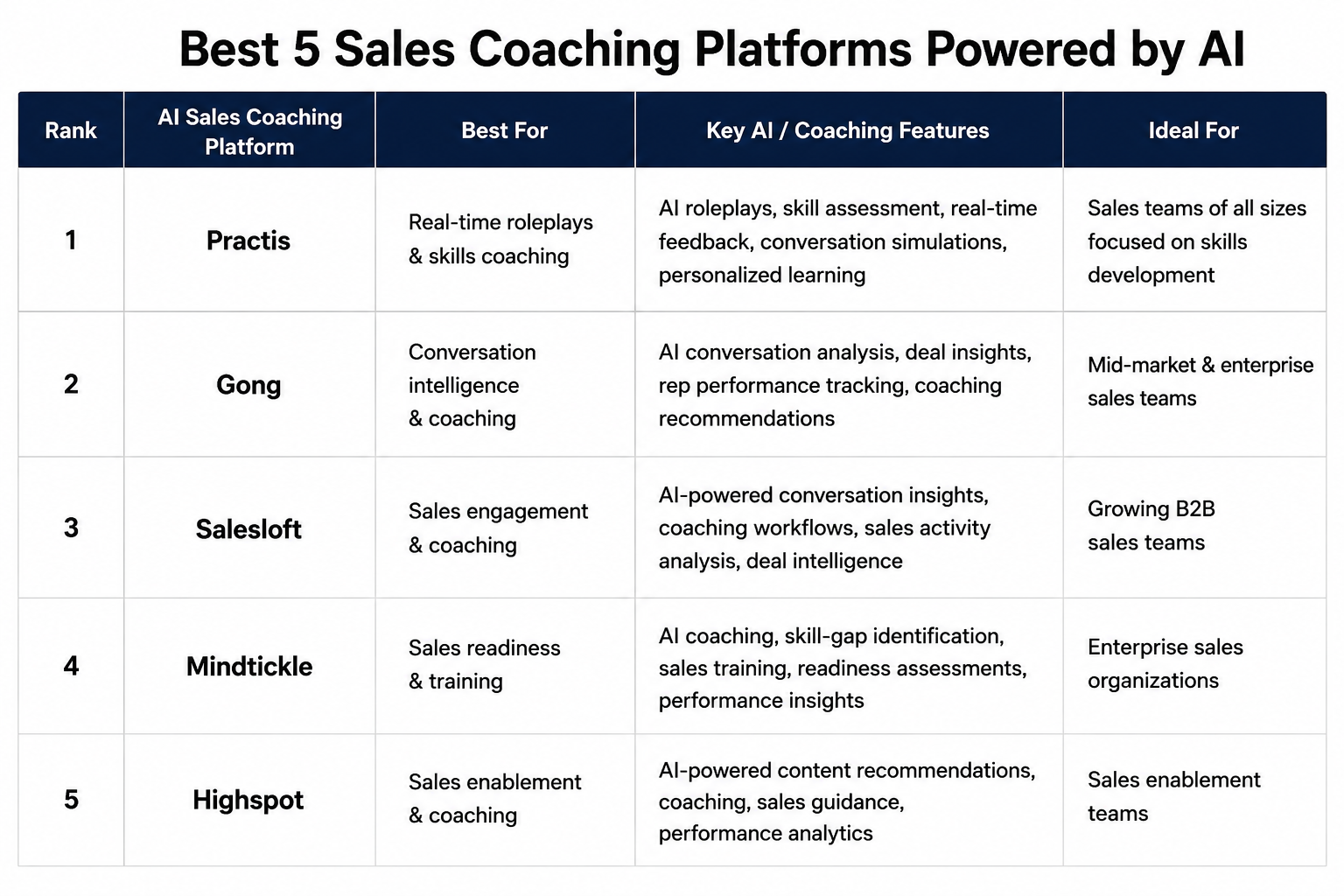
Below are five sales coaching platforms worth considering for U.S. sales teams.
1.Practis
Practis is an AI-powered sales coaching platform designed to help sales teams build stronger communication skills through realistic practice and personalized feedback. Instead of relying only on traditional classroom training or manager-led roleplays, Practis gives sales representatives opportunities to practice customer conversations in an interactive environment.
For sales managers and enablement leaders, Practis can also provide a more scalable approach to coaching. Instead of managers spending hours conducting the same roleplay exercises with every representative, AI can handle practice scenarios while managers focus their time on higher-value coaching and development.
Best for: Sales organizations looking for AI-powered roleplays, personalized practice, real-time feedback, and scalable sales skills development.
2. Gong
Gong is one of the best-known revenue intelligence platforms and has become widely used for conversation intelligence and sales coaching.
The platform uses AI to analyze customer interactions across calls, meetings, emails, and other sales activity. Managers can identify patterns in conversations and understand where representatives may need additional coaching.
One of Gong’s strengths is its ability to move coaching away from subjective opinions. Instead of telling a salesperson, “You need to ask better questions,” a manager can use conversation data to identify specific examples where discovery questions were missed or competitors were mentioned.
Gong can also help sales leaders understand what high-performing representatives are doing differently from the rest of the team.
Best for: Mid-market and enterprise sales organizations that want extensive conversation intelligence and revenue analytics.
3. Salesloft
Salesloft combines sales engagement, revenue workflow capabilities, conversation intelligence, and AI-driven insights.
For sales managers, its AI capabilities can help identify opportunities to improve rep performance while keeping coaching connected to the broader sales process. This is particularly useful for organizations that want sales coaching to be part of their daily workflow rather than a separate training activity.
Salesloft can help teams understand engagement patterns, evaluate conversations, and identify areas where representatives could improve their approach.
For field sales organizations, the ability to connect coaching insights with sales activities and pipeline management can make it easier for managers to understand both rep behavior and business outcomes.
Best for: Sales teams looking for a combination of sales engagement, coaching, and revenue workflow capabilities.
4. Mindtickle
Mindtickle takes a broader approach to sales readiness. Rather than focusing exclusively on conversation analysis, it combines sales training, coaching, readiness, and performance management.
This makes it particularly useful for companies with structured sales enablement programs.
AI can help sales leaders understand where representatives have knowledge or skill gaps and determine which areas deserve attention. Managers can then use coaching and training resources to address those gaps.
For U.S. companies with large sales organizations, this approach can be useful because onboarding and continuous development become increasingly difficult as teams grow.
Mindtickle is especially relevant when a company wants to connect training → coaching → rep readiness → sales performance rather than treating each activity separately.
Best for:Enterprise sales organizations with formal sales enablement and continuous learning programs.
5. Highspot
Highspot is another established sales enablement platform that has increasingly incorporated AI into sales workflows.
Its core strength is helping salespeople find and use the right content, training, and guidance during the selling process. AI can make this information easier to surface and can provide insights into how sales teams are using enablement resources.
For managers, this creates an opportunity to connect coaching with the actual materials and messaging representatives are expected to use.
For example, if a sales organization introduces a new product or changes its messaging, managers can use enablement and coaching capabilities to reinforce the new approach instead of relying entirely on classroom training.
Best for: Organizations that want AI coaching closely connected to sales enablement and content management.
How AI Sales Coaching Helps Field Sales Teams
Field sales teams have unique coaching challenges.
A manager may be responsible for dozens of representatives spread across different cities or territories. It is impossible to personally observe every customer meeting. AI can help fill some of that visibility gap.
1. More consistent coaching
AI can analyze sales interactions using consistent criteria. Managers can establish coaching priorities around discovery, objection handling, product positioning, competitive discussions, or closing techniques.
This can make coaching more structured across a geographically distributed team.
2. Faster feedback
Traditional coaching often happens after the fact. By the time a manager discovers that a rep repeatedly struggles with a particular objection, several opportunities may already have been lost.
AI-powered systems can surface patterns much sooner, allowing managers to address issues while they are still relevant.
3. Personalized development
Not every salesperson needs the same coaching.
One representative may need help with discovery questions, while another may need to improve follow-up discipline. AI can help managers identify individual patterns rather than assigning identical training to everyone.
4. Better visibility for sales leaders
AI coaching can provide managers with a broader view of team performance.
Instead of relying solely on CRM updates and subjective observations, leaders can combine conversation insights, activity data, pipeline information, and coaching observations.
5. More scalable coaching
Human managers remain essential, but AI can help them spend their time more effectively.
Rather than reviewing every conversation manually, a manager can use AI to identify the conversations or behaviors that deserve attention first. The manager then provides the human judgment, context, and encouragement that technology cannot fully replace.
What Should You Look for in an AI Sales Coaching Platform?
The best platform depends on your sales model and organization size. Before choosing one, U.S. sales leaders should consider several factors.
Conversation intelligence: Can the platform analyze calls and meetings accurately?
Coaching workflows:Can managers turn AI insights into practical coaching actions?
CRM integration: Does it connect smoothly with the CRM and sales tools your team already uses?
Field-sales usability: Can representatives and managers access insights easily when they are working remotely or traveling?
AI quality:Are the recommendations genuinely useful, or do they simply generate more dashboards and alerts?
Security and privacy:How does the vendor handle customer conversations, sales data, and sensitive business information?
Scalability:Can the platform support your organization as the sales team grows?
Manager experience: Most importantly, does the platform make managers better coaches rather than simply giving them more data?
AI Should Support Managers, Not Replace Them
It is easy to assume that AI will eventually automate sales coaching completely. In practice, the strongest use case is usually different.
AI is excellent at processing large amounts of information, identifying patterns, and bringing important moments to a manager’s attention. Human sales leaders are still better at understanding context, motivation, relationships, company culture, and the nuances of individual representatives.
The most effective model is therefore a partnership between AI and human coaching.