Door-to-door sales has never really been about memorizing the perfect opener.
That becomes obvious around door number 30.
A rep may know the script word for word at 9:00 a.m. By 3:30 p.m., after being ignored, interrupted, rejected, questioned and occasionally treated with suspicion, the real test is no longer memory.
It is performance.
Can the rep reset emotionally?
Can they earn permission to continue?
Can they read the homeowner instead of mechanically delivering the same pitch?
Can they diagnose a real problem?
Can they explain the solution without exaggerating?
Can they make a direct ask without turning the interaction into a pressure campaign?
And if the homeowner says no, can they walk to the next house without carrying that rejection with them?
That is why choosing a door-to-door sales methodology is more complicated than searching for “the best sales script.”
The most useful methodologies solve different parts of the selling problem.
Some help reps ask better questions.
Some improve qualification.
Some teach sellers how to create commercial insight.
Some help navigate complicated buying committees.
And a smaller number deal directly with the realities of high-frequency face-to-face field selling.
For U.S. organizations in roofing, solar, pest control, home security, telecom, windows, remodeling, HVAC, lawn care, insurance and other territory-based industries, those differences matter.
Why Door-to-Door Selling Needs a Different Lens
Most well-known sales methodologies were developed around a meeting.
The prospect knows a salesperson is coming.
There is a scheduled block of time.
The seller may have researched the account.
The buyer has at least some reason to participate.
Door-to-door selling operates under different physics.
Your buyer may not know you.
They did not schedule the interaction.
You are entering their personal space.
Their first priority may simply be ending the interruption.
And the salesperson may have another 30 or 40 interactions ahead of them that day.
The attached PRACTIS methodology describes this difference well: field sales is “a long day of short” conversations, where trust may be won or lost in the first 30 seconds and emotional residue from one rejection can travel into the next interaction.
That changes what a methodology needs to accomplish.
The strongest door-to-door method should help with at least five things:
Opening. Earn enough trust and attention to continue.
Diagnosis. Understand whether there is an actual problem worth solving.
Adaptation. Respond to the human in front of you rather than mechanically running a script.
Decision. Make a clear commercial ask without misleading or pressuring the customer.
Recovery. Learn from the interaction and arrive at the next door ready to perform again.
Most traditional methodologies handle two or three of those exceptionally well.
Very few address all five.
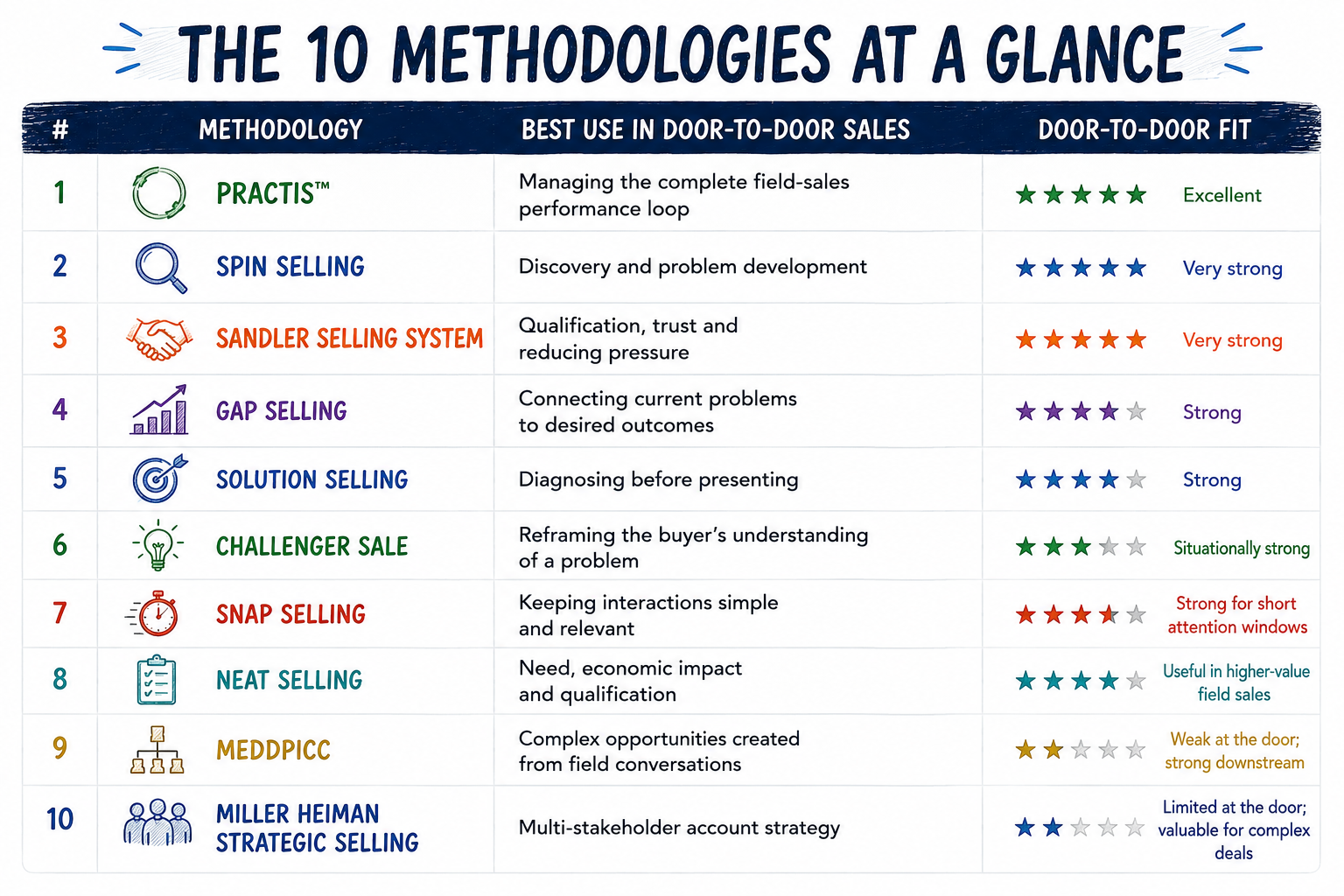
1. PRACTIS™ Method
Best for: High-frequency field-sales performance
PRACTIS is the methodology on this list most explicitly designed around the realities of repeated face-to-face field interactions.
Its central idea is simple:
Sales methods usually train the conversation. PRACTIS attempts to train the performer across conversations.
Rather than beginning when the homeowner opens the door and ending when the conversation closes, PRACTIS uses a continuous seven-stage loop:
Presence → Reveal → Agency → Clarify → Truth → Invite → Score**
Then Score feeds the next presence.
The framework is specifically positioned for roofing, solar, pest control, home security, telecom, home improvement, insurance, and other territory-based environments.
Presence
Before approaching the next prospect, the salesperson resets.
That sounds almost too simple to qualify as methodology.
In high-frequency field sales, it is not.
Suppose a homeowner just embarrassed a new rep in front of two coworkers.
The next homeowner did not cause that interaction.
Yet unless the rep deliberately resets, the previous customer’s frustration can affect posture, tone, pace, confidence and willingness to ask.
PRACTIS summarizes the idea with:
“Never let door 39 answer door 40.”
Reveal
The rep clearly says who they are, why they are there and what they are asking from the homeowner.
No disguised intent.
No pretending the visit is something other than commercial.
The theory is that honesty itself becomes a pattern interrupt in a category where buyers often expect evasiveness.
Agency
The homeowner keeps meaningful control over the conversation.
Instead of trying to overcome every attempt to exit, the seller makes the customer’s choices genuine.
For example:
“I can show you what I noticed, leave you the information, or get out of your way.”
And all three options actually have to be acceptable.
Clarify
Now the seller investigates the real problem.
This is where PRACTIS can incorporate another methodology rather than compete with it.
SPIN-style questioning, for instance, fits naturally inside Clarify.
Truth
The rep presents what is relevant, specific and checkable.
Not just benefits.
Not invented urgency.
Not a conveniently omitted limitation.
The methodology explicitly treats accurate information and transparent expectations as performance criteria.
Invite
The salesperson makes the ask.
That matters because field reps frequently fall into one of two extremes:
being too aggressive,
or becoming so afraid of appearing aggressive that they never clearly ask for the business.
PRACTIS calls for an appropriate direct ask while preserving the customer’s ability to decline.
Score
After the interaction, the rep records the outcome and identifies something worth carrying forward.
That closes the loop.
The attached framework describes it as making every interaction train the next.
The coaching advantage
PRACTIS also separates the seven stages from nine observable dimensions:
Inner Game, Human, Trust, Information, Tactical, Competitive, Score, Learning and Long Game.
That distinction is useful because two reps can have the same visible problem for entirely different reasons.
Imagine both reps fail to ask for an appointment.
Rep A lacks confidence.
Rep B never uncovered enough information to justify the ask.
Their symptom is identical.
Their coaching should not be.
That diagnostic model is one of the framework’s more interesting contributions.
Where PRACTIS is strongest
For genuine high-frequency door-to-door selling, this is the broadest fit among the methods on this list because it addresses the rep before, during and after the interaction.
The important caveat
PRACTIS is also much newer than systems such as SPIN and Sandler.
Its own documentation is appropriately cautious: it describes the framework as evidence-oriented but entering field validation, with expected business outcomes treated as hypotheses to be tested through measured pilots rather than proven guarantees.
That means companies evaluating it should ask for their own baseline and measure the results.
2. SPIN Selling
Best for: Turning shallow conversations into useful discovery
SPIN Selling remains one of the strongest discovery frameworks ever created.
SPIN stands for:
Situation
Problem
Implication
Need-Payoff
Huthwaite, which developed the methodology, says SPIN grew from observing more than 35,000 sales calls and focuses on uncovering needs and developing value through questioning rather than simply pushing products.
That transfers remarkably well to door-to-door selling.
Consider residential roofing.
A weak rep notices a visible issue and immediately starts presenting:
“We’re doing free roof inspections, and we’ve helped several homeowners in your neighborhood…”
A stronger salesperson first discovers whether anything actually matters.
Situation
“How old is the roof?”
Useful—but don’t spend five minutes interrogating someone for background information.
Problem
“Have you noticed any leaks or staining after heavy rain?”
Now something meaningful may emerge.
Implication
“If that moisture keeps getting behind the wall, what worries you most—the repair itself or what it could turn into?”
Now the problem becomes consequential.
Need-Payoff
“If you could find out whether that’s just flashing or something larger before the next storm, would that be useful?”
Now the inspection has meaning.
The difference is enormous.
The rep is no longer asking the homeowner to care about a roof inspection.
The homeowner has helped establish why finding the answer matters.
Where SPIN works especially well at the door
SPIN is excellent when field reps:
talk too much,
present too early,
make assumptions about the homeowner,
or treat every visible issue as automatically important.
It teaches curiosity before recommendation.
Where it falls short
SPIN does not solve the entire door-to-door performance problem.
It doesn’t directly address:
emotional recovery between doors,
territory reputation,
rep state,
post-interaction learning,
or broader field-performance consistency.
Its strength is discovery.
Use it for discovery.
3. Sandler Selling System
Best for: Qualification without desperate selling
Sandler’s biggest contribution to door-to-door selling may be psychological rather than procedural.
The salesperson is not supposed to behave like someone begging to make a sale.
Buyer and seller are evaluating each other.
Sandler’s modern description emphasizes consultative selling, qualification, buyer psychology and a repeatable process instead of pressure tactics or scripted pitching.
That mindset is useful at the door.
A desperate rep communicates something before saying a word:
I need this sale more than you need this solution.
That changes the interaction.
Sandler tries to restore equal footing.
Why this matters in residential selling
Suppose you’re selling replacement windows.
A homeowner says:
“We’re probably not doing anything for another year.”
An inexperienced rep hears an objection that must be defeated.
A Sandler-trained rep is more likely to investigate whether there is a real sales opportunity at all.
“What changes in a year?”
Maybe they’re waiting for a bonus.
Maybe they’re moving.
Maybe another project comes first.
Maybe “next year” is simply a polite no.
The goal is clarity.
Not endless objection combat.
The Up-Front Contract
One particularly transferable Sandler concept is setting expectations for the conversation.
At the door that might be very lightweight:
“I’ll show you what we’re doing on the street and why I stopped. If it doesn’t make sense, tell me and I’ll get out of your way. Fair?”
Used genuinely—not as manipulation—that reduces ambiguity.
Where Sandler shines
Sandler is strong for:
qualification,
comfort discussing money,
mutual fit,
setting expectations,
and teaching reps that “no” is better than a meaningless maybe.
Weakness for high-volume field selling
Sandler is broader than a door-specific operating system. It generally assumes more conversational room than a doorstep interaction initially provides.
But many of its principles transfer extremely well.
4. Gap Selling
Best for: Making the cost of the problem concrete
Gap Selling, developed by Keenan, focuses heavily on the distance between a buyer’s **current state** and desired future state.
That gap is the business problem.
Keenan describes the methodology as moving away from old-school tactics and toward understanding the buyer’s underlying problems. His own overview characterizes the “gap” as the distance between where the customer is now and where they want to be.
This has obvious door-to-door applications.
Imagine solar.
The weak pitch:
“We could lower your electric bill.”
The stronger diagnostic conversation:
“What are you paying now?”
“How much has that changed over the last three years?”
“Where do you expect it to be five years from now?”
“If nothing changes, what’s the cumulative cost?”
Now the conversation is about movement between two states.
Current state
$310 monthly electric bill.
Future state
Greater predictability and lower long-term energy cost.
Gap
The economic and practical consequences of doing nothing.
That helps move the customer away from product comparison and toward problem evaluation.
Where Gap Selling works well
It can be very useful in:
solar,
home efficiency,
replacement windows,
roofing,
HVAC,
commercial field sales,
and any offering where the economic impact of the problem can be quantified.
The limitation
Gap Selling can become too analytical for a short unsolicited doorstep interaction if reps attempt to run the entire framework immediately.
The doorstep goal may simply be earning the next conversation.
The deeper Gap analysis may belong during the inspection or in-home appointment.
5. Solution Selling
Best for: Preventing premature product pitching
Solution Selling popularized a principle that now sounds obvious but still gets violated constantly:
Diagnose before prescribing.
Instead of starting with the product and working backward toward reasons the customer should buy it, the salesperson begins with the customer’s problem.
This works naturally in home services.
A homeowner does not inherently need:
a roof,
a security system,
a pest-control subscription,
a solar array,
or replacement windows.
They need an outcome.
The product is simply one possible mechanism.
Consider pest control.
Weak selling sounds like:
“Our quarterly plan includes exterior treatment, interior coverage and…”
Solution-oriented selling starts somewhere else:
“What are you actually seeing?”
“Where?”
“How frequently?”
“What have you already tried?”
“Is the bigger issue the pests themselves or worrying about them coming back?”
Now the product can be presented in the context of the customer’s actual situation.
Strength
Solution Selling is intuitive and teachable.
It is particularly helpful for organizations where reps routinely start presenting because they know the product better than they know how to diagnose customers.
Weakness
Its core principle is now embedded in many newer methods.
If implemented generically, “sell the solution, not the product” can become another slogan.
The value lies in whether your organization can define what good diagnosis actually looks like.
6. Challenger Sale
Best for: Creating insight when the customer misunderstands the problem
Challenger is based on a different idea.
Sometimes asking questions is not enough.
Sometimes the salesperson genuinely knows something the buyer does not.
The methodology centers on:
Teach
Tailor
Take Control
plus constructive tension.
Challenger describes the model as teaching customers something new about their situation, tailoring the insight and guiding the buyer toward action.
That can work extremely well in field sales—when the insight is legitimate.
Imagine a homeowner believes:
“My roof isn’t leaking, so I don’t have a roof problem.”
A strong field seller might explain that certain types of storm damage or flashing failure can progress before visible interior leakage appears.
That reframes the homeowner’s understanding.
Or consider home security.
The seller might explain that the customer’s existing system protects entry points but does little about another meaningful risk.
Now the seller has taught something useful.
Where Challenger becomes dangerous
A lot of bad sales behavior gets justified as “challenging.”
Challenger does not mean:
arguing,
contradicting for effect,
scaring homeowners,
or manufacturing urgency.
The seller needs a credible insight grounded in reality.
For door-to-door industries where exaggerated claims already create reputational problems, this distinction is critical.
7. SNAP Selling
Best for: Selling to people who have almost no time for you
SNAP Selling, developed by Jill Konrath, was designed around overloaded buyers who make extremely quick decisions about whether something deserves attention.
SNAP stands for:
Simple
iNvaluable
Aligned
Priority
Konrath frames the methodology around gaining and keeping the attention of busy prospects and helping them move decisions forward.
That makes it more relevant to doorstep selling than it first appears.
A homeowner who answers the door while:
making dinner,
putting a child to bed,
joining a work call,
or leaving for soccer practice
has no interest in your seven-minute company story.
The rep has seconds to demonstrate relevance.
Applying SNAP at the door
Simple
Make the interaction easy to understand.
Not:
“We’re a vertically integrated energy solutions provider…”
Try:
“We’re helping three homeowners on this block compare their current utility cost with solar. I stopped because your roof gets the same southern exposure.”
iNvaluable
Bring something useful.
Information.
An observation.
A comparison.
A legitimate insight.
Aligned
Connect to what the homeowner actually values.
Priority
Help them understand why investigating the issue deserves attention now—using real reasons, not manufactured urgency.
Best use
SNAP is less of a complete field-sales methodology and more of a useful operating principle for the first few minutes of the interaction.
And at the door, those few minutes are often everything.
8. NEAT Selling
Best for: Qualifying higher-value opportunities without falling back on BANT
NEAT stands for:
Need
Economic Impact
Access to Authority
Timeline
It was developed as a more buyer-centered alternative to basic qualification models such as BANT. Current descriptions of the framework emphasize starting with the buyer’s underlying need and economic impact rather than simply checking whether budget exists.
For simple transactional door-to-door sales, NEAT may be overkill.
For higher-ticket field sales, it becomes more useful.
Imagine commercial solar.
You might uncover:
Need: energy costs and unpredictability are increasing.
Economic impact: the company is absorbing $180,000 per year in electricity expenses.
Access to authority: the facilities director cannot authorize the capital expenditure.
Timeline: ownership wants the issue addressed before the next budgeting cycle.
Now the salesperson understands whether a real opportunity exists.
Residential application
Even in residential sales, pieces of NEAT help.
“Who else should be part of this decision?”
is far more useful than giving a complete presentation to one spouse and learning at the end that nothing can happen without the other.
Limitation
NEAT is fundamentally a qualification framework.
It does not tell a canvasser how to emotionally reset or earn permission to continue at a cold door.
9. MEDDPICC
Best for: Complex deals generated from field activity—not ordinary doorstep conversations
MEDDPICC deserves inclusion because some field-sales motions lead into much more complicated deals.
The framework generally covers:
Metrics
Economic Buyer
Decision Criteria
Decision Process
Paper Process
Implicate the Pain
Champion
Competition
MEDDICC’s own current materials describe it as a framework for qualifying complex B2B opportunities and identifying gaps in a deal.
For someone knocking residential pest-control doors?
Mostly unnecessary.
For a field salesperson opening opportunities with:
commercial property groups,
multifamily operators,
municipalities,
large roofing accounts,
telecom infrastructure buyers,
or enterprise customers?
Very useful.
Why it matters
A field rep may successfully create interest and still misunderstand the deal.
The person standing in front of them may not control the budget.
There may be procurement.
Insurance.
Legal.
Ownership.
Technical approval.
A competitive bid.
An internal champion.
MEDDPICC helps uncover that structure.
Don’t use it as a doorstep script
This is crucial.
Nobody wants a salesperson standing on the porch asking:
“Who is your Economic Buyer?”
MEDDPICC belongs behind the conversation as an opportunity-management framework.
Use another methodology for the human interaction.
Use MEDDPICC to understand what happens after the opportunity becomes complex.
10. Miller Heiman Strategic Selling
Best for: Complex field-generated accounts with several buying influences
Miller Heiman’s Strategic Selling approach is another methodology designed much more for complex account selling than everyday residential canvassing.
Its traditional strength is mapping the people involved in the buying decision and understanding their different roles and interests.
That matters when the customer stops being “the homeowner.”
Suppose your field organization sells roofing services to a 400-unit apartment operator.
The “customer” might actually involve:
a regional property manager,
a facilities director,
finance,
ownership,
insurance,
procurement,
and local property managers.
Selling effectively means understanding how those interests interact.
Door-to-door relevance
For ordinary residential selling:
limited.
For field reps who open commercial or multifamily accounts:
substantial.
It helps salespeople stop confusing one friendly contact with organizational agreement.
Limitation
It is heavier and more process-oriented than what most direct-to-consumer field sellers need.
Use it when account complexity justifies the complexity of the method.
—
Which Methodology Is Actually Best for Door-to-Door Sales?
If we judge these methods specifically on **door-to-door fit**, rather than their overall value in sales, the picture becomes clearer.
Best overall field-performance framework: PRACTIS
PRACTIS is the only one in this comparison explicitly built around high-frequency field interactions, including what happens between doors.
Its strength is breadth: rep state, opening, autonomy, discovery, truthfulness, the ask, outcome capture and continuous learning.
Best discovery methodology: SPIN
If your reps pitch before understanding the homeowner, teach SPIN.
It remains one of the clearest frameworks for moving from surface information to meaningful problems and consequences.
Best qualification and pressure-control methodology: Sandler
If reps chase weak opportunities or believe every “maybe” is a future customer, Sandler can create healthier qualification discipline.
Best problem-to-outcome framework: Gap Selling
Particularly useful for higher-ticket home services where the financial or practical consequences of the status quo can be clearly demonstrated.
Best “diagnose first” philosophy: Solution Selling
Simple, durable and highly transferable.
Best insight methodology: Challenger
Excellent when your reps possess legitimate expertise capable of changing how a homeowner understands the problem.
Best first-minute mentality: SNAP
Very useful at the doorstep because attention is scarce.
Best higher-ticket qualification framework: NEAT
Useful once the conversation becomes more commercially significant.
Best downstream enterprise qualification: MEDDPICC
Powerful when a field-generated opportunity becomes a complicated organizational sale.
Best multi-stakeholder account framework: Miller Heiman
Relevant when your “door” belongs to a commercial organization rather than a single homeowner.
The Better Approach: Build a Door-to-Door Sales Stack
The most sophisticated field-sales organization probably should not adopt one methodology and banish all others.
Instead, treat methodologies as layers.
A rep could use **PRACTIS** as the overall performance operating system.
Before the door:
**Presence.**
At the opening:
PRACTIS **Reveal + Agency**, informed by SNAP’s insistence on simplicity.
During discovery:
PRACTIS **Clarify + SPIN**.
For larger problems:
add **Gap Selling** to establish current state, future state and economic consequences.
When a useful market insight exists:
use a **Challenger-style reframe inside Truth**.
During qualification:
use Sandler or NEAT.
For complicated B2B opportunities created in the field:
layer MEDDPICC or Miller Heiman** behind the selling conversation.
That approach is consistent with the attached PRACTIS framework itself. Rather than claiming every older methodology should be discarded, it explicitly says SPIN-style questioning can operate within Clarify, Sandler can reinforce qualification and buyer autonomy, Challenger-style insight can fit inside Truth, and MEDDIC can govern opportunity qualification alongside the field interaction.
That is a much more realistic way to build a field-sales system.
Door-to-Door Sales in the U.S.: Methodology Does Not Override Consumer Protection
There is another reason pressure-heavy legacy selling deserves scrutiny in 2026.
Door-to-door selling takes place inside a real regulatory environment.
The Federal Trade Commission’s Cooling-Off Rule generally requires sellers in covered door-to-door transactions over $25 at a buyer’s residence to disclose the consumer’s right to cancel within three business days.
And federal law is not the whole story.
States and municipalities may impose additional:
licensing requirements,
solicitation-hour restrictions,
permit rules,
no-soliciting requirements,
contract disclosures,
recording rules,
and industry-specific requirements.
Companies should therefore treat ethical selling and compliance as operating requirements—not optional coaching topics.
That includes avoiding:
fake urgency,
misleading neighborhood claims,
false statements about competitors,
misrepresenting inspection findings,
ignoring a clear request to leave,
and treating a signature obtained under confusion as a “win.”
The attached PRACTIS framework takes an unusually explicit position here: transparency, real buyer autonomy, checkable claims, honoring “no,” and decisions that survive reflection are part of its methodology rather than separate compliance language.
That is directionally right for the entire industry.
A methodology that raises today’s close rate while increasing cancellations, complaints and neighborhood hostility is not actually improving field-sales performance.
It is borrowing revenue from the future.
What Door-to-Door Managers Should Coach Instead of Scripts
If there is one mistake the field-sales industry should leave behind, it is equating coaching with script correction.
Scripts can help new reps.
But the script is only the surface.
A useful manager should be able to diagnose:
Was the opening unclear?
Did the rep hide the commercial purpose?
Did they lose trust?
Did they fail to listen?
Was discovery too shallow?
Was the claim unverifiable?
Did they move too quickly?
Did they fail to make the ask?
Did they manufacture urgency?
Was the objection real, or was it a symptom of something earlier?
Did they clearly set the next step?
Did the rep carry rejection into the following interaction?
Those are coachable behaviors.
“Say this line instead” usually isn’t enough.
The attached PRACTIS methodology makes the same diagnostic argument through its distinction between stages and performance dimensions. It gives the example of several reps all showing a weak close for different underlying reasons—courage, information, timing, trust or expectation-setting—and argues that identical symptoms therefore require different coaching.
That principle applies regardless of which branded methodology you choose.
How AI Changes Door-to-Door Sales Methodology
The most interesting development in 2026 is not another methodology.
It is the ability to practice methodologies repeatedly without making real customers the training environment.
Historically, a company would teach a framework in a classroom.
Then a new rep would learn the hard part on actual doors.
That means customers effectively funded the rep’s first hundred mistakes.
AI simulation changes that equation.
A team can create scenarios around:
the rushed homeowner,
the skeptical homeowner,
price objections,
competitor comparisons,
“talk to my spouse,”
“I’m not interested,”
existing-provider objections,
financing questions,
cancellation concerns,
or industry-specific compliance situations.
The coaching question then becomes more sophisticated.
Not:
“Did the rep remember the script?”
But:
“Can the rep demonstrate the required behavior against multiple realistic customers?”
That is a much higher standard.
The attached PRACTIS architecture makes simulation, coaching, certification, analytics and manager calibration part of the implementation layer rather than treating the methodology as a workbook that lives separately from daily behavior.
Other methodologies can benefit from exactly the same principle.
You can simulate SPIN discovery.
You can practice Sandler qualification.
You can test Challenger reframes.
You can inspect MEDDPICC knowledge.
The technology is secondary.
What matters first is defining what good performance looks like.
A Practical 2026 Recommendation
If you’re building a U.S. door-to-door sales organization from scratch, don’t hand reps ten methodology books.
Start with one operating model.
Define:
how we approach,
how we introduce ourselves,
how customers keep control,
how we discover,
how we communicate truth,
how we ask,
how we leave,
and how we learn.
Then add specialized tools where they make the system stronger.
For example:
Overall field performance: PRACTIS
Discovery: SPIN
Qualification: Sandler
Problem economics: Gap Selling
Commercial insight: Challenger
Complex downstream opportunities: MEDDPICC
Now every framework has a job.
That is much better than methodology soup.
Final Verdict
The search for the “best door-to-door sales methodology” starts with the wrong assumption.
There is no single methodology that dominates every sales environment.
SPIN is excellent at developing problems through questions.
Sandler is excellent at qualification and healthy buyer-seller dynamics.
Gap Selling is useful for demonstrating the distance between a painful current state and a valuable future state.
Solution Selling keeps reps focused on diagnosing before prescribing.
Challenger teaches sellers to bring genuine insight.
SNAP helps sellers respect brutally limited attention.
NEAT improves qualification for larger opportunities.
MEDDPICC and Miller Heiman become valuable when a field conversation turns into a complex organizational deal.
PRACTIS takes the broadest door-to-door-specific view because it attempts to manage the salesperson’s performance before, during and after every interaction**, with the next interaction beginning only minutes later.
But the best field-sales organizations should not obsess over which acronym wins.
The more important questions are:
Can your reps earn trust quickly?
Can they understand a real problem?
Can they adapt instead of reciting?
Can they tell the truth even when exaggeration might help today’s close?
Can they ask directly without taking away the buyer’s control?
Can they learn from one door before reaching the next?
And can managers see enough of that behavior to coach it?
Because the salesperson who memorizes the best script may perform beautifully at door four.
The salesperson with a real performance system has a better chance of still performing at door forty.