Sales enablement has changed significantly in the United States.
Not long ago, a sales enablement program might have meant a shared folder full of presentations, a training portal, a few product sheets, and a quarterly sales meeting. Today, that approach is rarely enough for a modern revenue organization.
Sales teams are dealing with more products, more buyer research, longer buying committees, increasingly sophisticated competitors, and higher expectations from customers. At the same time, sales leaders are expected to improve rep productivity without simply adding more meetings, more software, or more administrative work.
That is why sales enablement platforms have become an important part of the modern revenue technology stack.
The strongest platforms are no longer just content libraries. They are bringing together sales content, training, coaching, AI, buyer engagement, analytics, roleplay, readiness, and guidance into connected workflows.
For U.S. companies evaluating these platforms in 2026, there is another important consideration: the market itself is changing quickly. Highspot and Seismic completed their merger in August 2026, creating a combined Seismic organization serving about 2,500 customers and 3.5 million users. Showpad has also completed its combination with Bigtincan and now positions itself as an AI-native revenue-effectiveness platform built particularly around complex field-selling environments.
So, which sales enablement platforms are worth considering?
More importantly, what should a U.S. sales leader actually look for?
What Is a Sales Enablement Platform?
A sales enablement platform gives customer-facing teams the resources, knowledge, training, coaching, and insights they need to perform more effectively throughout the sales process.
The traditional definition focused heavily on content.
The modern definition is much broader.
A salesperson may need the right presentation before a meeting, a competitive battlecard during the conversation, training to understand a new product, coaching after a difficult call, and AI-powered guidance when an opportunity starts to stall.
A good enablement platform tries to connect those moments.
Mindtickle’s 2026 market overview describes the category as increasingly combining training, content, coaching, and conversation intelligence, reflecting the broader move from traditional “sales enablement” toward revenue enablement.
That shift is important because the real business question is no longer:
“Did our reps receive the content?”
It is:
“Did the content, training, and coaching help the rep perform differently—and did that change affect revenue?”
That is a much harder question, but it is also the question that matters.
Why Sales Enablement Matters More Than Ever
One of the biggest problems inside modern sales organizations is the gap between what leadership wants sellers to do and what sellers actually do.
Marketing may launch a new positioning strategy.
Sales leadership may introduce a new methodology.
Enablement may create a new playbook.
Product marketing may publish updated competitive messaging.
But none of those initiatives automatically changes behavior.
A salesperson still has to remember the information, understand it, believe in it, and use it naturally with a real buyer.
This is the know-do gap.
Sales enablement platforms are increasingly trying to close that gap by connecting information with practice, coaching, and real-world execution.
Highspot, for example, now positions its platform around four connected activities: equipping sellers with content, training them, guiding active deals, and coaching performance.
Seismic similarly describes its platform as bringing together enablement execution, buyer and customer engagement, coaching and development, and enablement strategy.
This is where the category is heading.
Top Sales Enablement Platforms for U.S. Sales Teams
There is no universal “best” platform.
The right choice depends on the company’s size, sales motion, industry, field complexity, existing CRM, content requirements, coaching model, and maturity of its enablement function.
Here are the platforms that deserve serious consideration.
1.Practis
Practis is designed for high-frequency field sales teams that need to improve real-world selling performance through continuous practice, coaching, and feedback. Its PRACTIS™ Method follows seven stages: Presence, Reveal, Agency, Clarify, Truth, Invite, and Score.
The framework also evaluates sales performance across nine dimensions, including Inner Game, Human, Trust, Information, Tactical, Competitive, Score, Learning, and Long Game. This allows coaching to focus on specific behaviors rather than simply measuring whether a salesperson completed training.
A key strength of Practis is its focus on repeated field interactions. Rather than relying on word-for-word scripts, the methodology gives salespeople a consistent performance structure while allowing them to adapt naturally to different customers and situations.
2. Seismic
Best for Enterprise-Scale GTM Performance
is one of the most important names in enterprise sales enablement.
And in 2026, its position in the market has changed substantially.
On August 18, 2026, Seismic announced that its merger with Highspot had been completed. The combined company operates under the Seismic name and brings together AI agents, content governance, performance insights, and revenue-execution capabilities. Seismic says the combined organization now serves approximately 2,500 customers and 3.5 million users worldwide.
That makes Seismic particularly relevant for large U.S. enterprises looking for a broad platform rather than a collection of disconnected enablement tools.
Seismic’s Enablement Cloud combines resources, training, coaching, AI-powered insights, and workflows for customer-facing teams.
The platform is especially attractive for organizations where content governance matters.
Think about a large healthcare, financial-services, technology, manufacturing, or pharmaceutical organization.
A sales rep cannot simply find an old PDF on a shared drive and send it to a customer.
The company needs to know:
Is the content current?
Was it approved?
Is the messaging compliant?
Which version should the rep use?
What is actually being used?
Is that content associated with better outcomes?
Those questions become more important as organizations scale.
Seismic also reports that approximately 2,000 organizations were using its platform before the Highspot combination, with customer examples showing improvements in areas such as content usage, ramp time, and pipeline creation. These are vendor-reported outcomes rather than independent benchmarks, so buyers should validate them against their own baseline.
Best for: Large enterprises, regulated industries, global GTM organizations, content governance, and organizations seeking a broad enablement platform.
Strength: Enterprise scale, governance, content, coaching, and GTM performance.
Consider: Because the Highspot merger is extremely recent, buyers should ask detailed questions about product consolidation, roadmap priorities, integrations, contracts, and implementation plans.
3. Showpad
Best for Field Sales and Complex Products
is particularly interesting for U.S. companies with field-heavy sales organizations.
Its current positioning is different from a traditional content-management platform.
Showpad now calls itself an AI-native revenue-effectiveness platform designed for field-selling-centric organizations. Its platform brings together content management, sales readiness, buyer engagement, analytics, and AI through Showpad Genie.
That field focus matters.
Consider a medical-device representative visiting a hospital.
Or a manufacturing salesperson walking through a plant.
Or an industrial sales rep discussing hundreds of SKUs with a procurement team.
The seller needs more than a generic sales deck.
They need product specifications, approved information, pricing context, competitive information, customer-specific materials, and confidence that the information they are presenting is accurate.
Showpad’s combination with Bigtincan is now complete, and the company says the unified platform was specifically designed for mobile-first, field-selling environments. It includes offline capabilities, which can be especially valuable for sellers working in facilities or locations where connectivity is unreliable.
Showpad also offers sales readiness, content management, buyer engagement, and analytics within the same ecosystem.
For field sales, that combination can be meaningful.
The salesperson can prepare before the meeting, access the right content during the meeting, engage buyers digitally, and capture insights afterward.
Best for: Field sales, manufacturing, medical devices, CPG, industrial technology, complex products, and mobile sellers.
Strength: Field-first enablement with content, readiness, buyer engagement, and AI.
Consider: Smaller inside-sales teams may not need the breadth of a field-oriented enterprise platform.
4. Mindtickle
Best for Sales Readiness and Certification
approaches sales enablement through the concept of readiness.
That makes it especially relevant for organizations that want to know whether representatives are actually prepared to sell—not simply whether they completed a training course.
Mindtickle’s platform combines learning, coaching, content, conversation intelligence, certification, and AI roleplay. Its 2026 platform positioning emphasizes connecting rep readiness with live sales execution.
This is particularly useful for large sales organizations with complex onboarding requirements.
Imagine a company hiring 100 new sales representatives.
Leadership may need those representatives to learn:
- The product portfolio
- Competitive positioning
- Pricing
- Sales methodology
- Discovery
- Objection handling
- Industry-specific messaging
- Compliance requirements
- CRM processes
A traditional LMS can confirm that the reps completed their courses.
A readiness platform can go further by testing whether they can actually perform.
Mindtickle’s AI roleplay capability allows sellers to practice conversations against AI buyers and receive feedback. Its broader platform also provides readiness scoring and coaching workflows.
That makes Mindtickle particularly attractive for organizations where onboarding and certification are major business processes rather than simple HR requirements.
Best for: Enterprise sales readiness, onboarding, certification, coaching, and structured skill development.
Strength: Measuring whether sellers are genuinely ready to perform.
Consider: Sophisticated readiness systems can require substantial setup, governance, and ongoing administration.
5. Highspot
Best for Connected Content, Training, and AI Coaching
remains an important name in sales enablement even though its merger with Seismic has now been completed.
Before the merger, Highspot had developed a broad platform combining sales content, training, coaching, buyer engagement, AI roleplay, analytics, and guided selling.
Its current product pages emphasize a connected approach:
Equip → Train → Guide → Coach.
Highspot’s AI can identify skill gaps, personalize training, recommend content, guide active deals, and provide coaching feedback.
That is useful because enablement is rarely just about content.
Suppose a company launches a new product.
A weak enablement process might upload a product deck and send an email.
A stronger process might identify which reps need training, assign role-specific learning, provide practice scenarios, recommend the right content during opportunities, and help managers coach the new skill.
That is the direction Highspot has been taking.
Its integration ecosystem also connects with tools such as Salesforce, Microsoft, Slack, and other GTM applications, allowing enablement capabilities to appear inside existing workflows.
Because Highspot is now part of Seismic, however, the most important question for new buyers is no longer simply “Is Highspot good?”
It is:
How will the combined Seismic platform evolve, and which Highspot capabilities will remain, merge, or become part of the broader Seismic product strategy?
That should be part of every current evaluation.
Best for: Organizations that value connected content, training, coaching, guided selling, and AI.
Strength: Strong integration between enablement activities and GTM execution.
Consider: Current product and roadmap implications following the August 2026 merger.
6. Allego
Best for Unified Learning and Revenue Enablement
takes a unified revenue-enablement approach.
The platform brings together content management, modern learning, AI roleplay and coaching, digital sales rooms, and conversation intelligence.
That makes Allego appealing to organizations trying to reduce fragmentation.
Instead of having:
one system for training,
another for content,
another for roleplay,
another for conversation intelligence,
and another for buyer engagement,
a company can consider a platform designed to connect those functions.
Allego also emphasizes mobile-first learning and asynchronous, video-based coaching, which can be useful for distributed teams.
That matters in the United States because sales organizations are increasingly hybrid.
A rep might work remotely one day, visit customers the next, and join an internal coaching session later in the week.
Training has to fit into that workflow.
Allego also positions its AI capabilities around real-time guidance, risk identification, next steps, roleplay, and coaching.
Best for: Unified revenue enablement, distributed teams, learning, coaching, content, and digital selling.
Strength: Broad platform coverage.
Consider: Comprehensive platforms require thoughtful implementation; more features do not automatically mean better adoption.
7. Gong
Best for Conversation Intelligence and Coaching
is slightly different from traditional enablement platforms.
Its strength is conversation intelligence.
Rather than starting with the question, “What content should we give our reps?”, Gong starts with the question:
“What is actually happening in our customer conversations?”
That can be extremely valuable for sales managers.
A manager may believe that a rep is losing deals because of pricing.
Conversation data might show something different.
Perhaps the rep is discussing price too early.
Perhaps they are talking too much.
Perhaps they are failing to establish business impact.
Perhaps successful reps are handling the same objection differently.
This is where conversation intelligence becomes a coaching resource.
Gong’s AI analyzes customer interactions and helps organizations identify patterns across calls, deals, and seller behavior.
For inside-sales and B2B organizations where customer conversations are frequently recorded, this can be powerful.
But there is an important limitation.
If your team does most of its selling face-to-face, a platform built around recorded calls may not capture the entire sales experience.
That is why Gong may be a better fit for an inside-sales or hybrid organization than for a pure field-sales organization.
Best for: B2B sales, inside sales, call-heavy teams, conversation intelligence, and manager coaching.
Strength: Learning from real customer conversations.
Consider: Whether enough of your real sales activity is captured digitally.
8. Mediafly
Best for Value Selling and Revenue Intelligence
is another platform worth considering for organizations where value selling is central to the sales process.
Mediafly is commonly associated with sales content, value selling, guided selling, revenue intelligence, and sales enablement.
This can be particularly useful for complex B2B organizations where the seller must build a financial or business case rather than simply explain product features.
A modern enterprise buyer may ask:
“Why should we change?”
“What will this save us?”
“How quickly will we see the return?”
“How does this compare with doing nothing?”
That requires more than product knowledge.
It requires value communication.
For companies with complex sales cycles, Mediafly can therefore be worth evaluating alongside broader platforms such as Seismic, Showpad, Mindtickle, and Allego.
Mindtickle’s current 2026 market comparison also lists Mediafly among the leading sales enablement platforms, highlighting its value-selling and revenue-intelligence positioning.
Best for: Value selling, complex B2B sales, revenue intelligence, and organizations where financial justification is central to the buying process.
Strength: Connecting selling activities with value communication and revenue insights.
9. SalesHood
Best for Mid-Market Enablement
is worth considering for organizations that want a sales-enablement platform without necessarily adopting the full complexity of a large enterprise ecosystem.
Mindtickle’s 2026 comparison identifies SalesHood as a fast-deploying mid-market enablement option.
This category matters because not every U.S. sales organization has a 100-person enablement department.
A growing company may have:
50 sales reps,
2 sales enablement leaders,
a small marketing team,
and a sales manager who is already overloaded.
That organization may need training, content, coaching, and readiness—but it may not need an enormous implementation project.
SalesHood can therefore be worth including in a mid-market shortlist.
Best for: Mid-market companies and teams looking for practical sales enablement without an enterprise-scale technology footprint.
Strength: Accessibility and faster deployment.
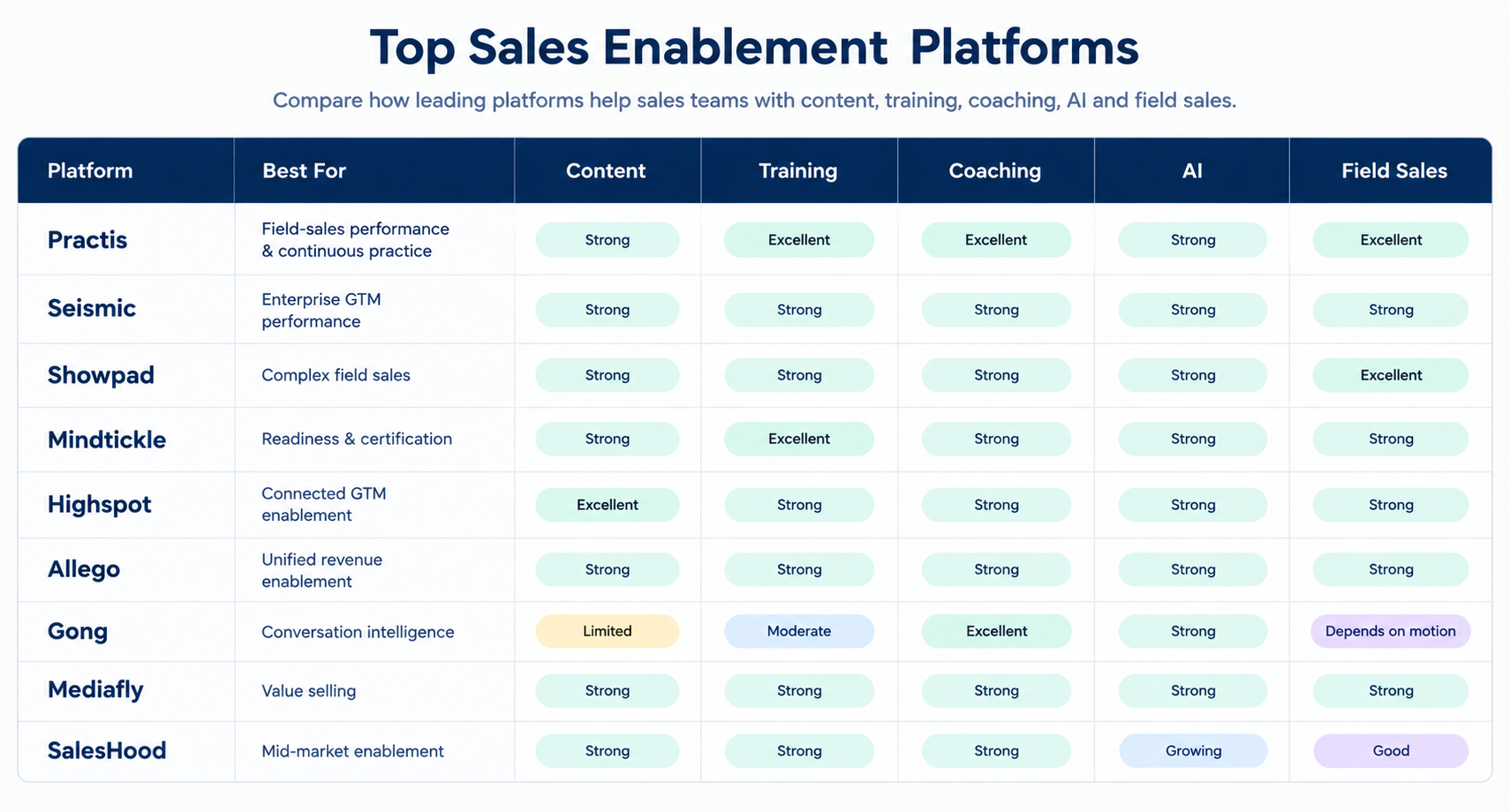
This is not a universal ranking.
A platform can be excellent for one sales organization and completely unnecessary for another.
The Most Important Change: Sales Enablement Is Becoming Revenue Enablement
One of the most interesting changes in this market is the language itself.
The industry increasingly talks about revenue enablement, revenue effectiveness, and GTM performance instead of simply sales enablement.
That is not just marketing language.
It reflects a genuine change in what companies expect these platforms to do.
Traditional enablement often measured:
content downloads,
course completion,
training attendance,
certifications,
and asset usage.
Those metrics are useful, but they are activity metrics.
Revenue leaders increasingly want to know whether enablement changes:
ramp time,
pipeline creation,
conversion,
win rate,
deal velocity,
average deal size,
retention,
and revenue.
Showpad explicitly frames its current platform around revenue effectiveness, while Seismic describes its post-merger direction around GTM performance and turning strategy into revenue execution.
That is a much more business-oriented approach.
Why AI Is Changing Sales Enablement
AI is probably the biggest technology shift affecting this category.
But AI itself is not the value.
The value comes from what AI enables the sales organization to do.
For example, AI can help a company identify that a particular group of reps is struggling with discovery.
The system can then recommend targeted training.
The reps can practice discovery through AI roleplay.
The platform can score the practice.
Managers can review the results.
The reps can return to live customer conversations.
Then the organization can compare behavior and outcomes.
That creates a loop.
Identify → Practice → Coach → Apply → Measure → Improve
This is much more powerful than simply uploading another training video.
Highspot currently describes this type of connected model, with AI identifying skill gaps, personalizing learning, enabling roleplay, guiding deals, and scaling coaching.
Mindtickle similarly connects readiness, AI roleplay, coaching, and conversation intelligence.
Where Practis Fits Into the Sales Enablement Conversation
This is where Practis deserves attention, particularly for organizations with high-frequency field sales.
Practis approaches sales performance from a somewhat different starting point.
Instead of treating enablement primarily as a collection of content and training resources, the PRACTIS™ Method is designed as a performance operating system for high-frequency field sales.
The methodology structures performance before, during, and after an interaction through seven stages:
Presence → Reveal → Agency → Clarify → Truth → Invite → Score.
The framework is designed around the reality that field representatives may have many short, emotionally variable, face-to-face interactions during a day.
That distinction matters.
A traditional B2B sales conversation might last 45 minutes.
A field-sales interaction may last a few minutes—or even less.
The rep has to reset from the previous interaction, establish trust quickly, understand the customer, communicate accurate information, make an appropriate ask, and then learn from the outcome.
Practis calls attention to that entire performance cycle.
Practis Is Not Simply Another Sales Script
One of the more interesting aspects of the PRACTIS framework is that it explicitly avoids being a word-for-word script.
The methodology defines stages and observable qualities of performance instead, allowing representatives to adapt to real customers while maintaining a consistent performance standard.
That is important.
A script can tell a rep what to say.
A performance framework can help a rep understand what they need to accomplish.
Those are not the same thing.
A customer may respond differently from the expected script.
If the salesperson only memorized the words, they may become stuck.
If they understand the purpose of the interaction stage, they have more room to adapt.
Seven Stages Are Only One Part of the Framework
The PRACTIS Method also uses nine performance dimensions:
Inner Game, Human, Trust, Information, Tactical, Competitive, Score, Learning, and Long Game.
This creates a useful distinction.
The seven stages describe where the rep is in the interaction.
The nine dimensions describe how the rep is performing.
That means two salespeople can fail at the same stage for completely different reasons.
For example, two representatives may both fail to close.
One may have weak discovery.
Another may have poor confidence.
Another may have created an untrustworthy interaction.
Another may have done everything well but failed to make a clear invitation.
If coaching simply says, “Close better,” the root problem remains.
A more useful system identifies the behavioral issue.
How Practis Can Complement Traditional Sales Methodologies
Practis does not position itself as a replacement for established sales methodologies such as SPIN, Sandler, Challenger, or MEDDIC.
Instead, the methodology describes itself as a performance layer in which those methods can operate.
That is a sensible distinction.
SPIN can help structure discovery.
Sandler can help with qualification and upfront contracts.
Challenger can help salespeople communicate commercial insight.
MEDDIC can help with opportunity qualification.
But none of those methods alone necessarily addresses the complete performance cycle of a high-frequency field salesperson.
Practis is designed to fill that layer.
Why Field Sales Deserves Special Attention
Field sales is often treated as if it were simply inside sales without a headset.
It is not.
The environment is different.
A field representative may deal with:
unpredictable customer availability,
short conversations,
physical environments,
repeated rejection,
territory dynamics,
limited preparation time,
face-to-face trust signals,
and dozens of interactions in a single day.
That means enablement needs to work differently.
The platform must be easy to use.
The information must be accessible.
Training should be practical.
Practice should resemble reality.
And coaching should focus on behavior.
Showpad is one of the major enterprise platforms explicitly emphasizing this field-first reality, including offline access and mobile workflows.
Practis approaches the same broader challenge from the performance side, with a methodology designed specifically around repeated field interactions.
For companies with large field organizations, those distinctions are worth paying attention to.
What Should a U.S. Company Look for in a Sales Enablement Platform?
Choosing a platform should start with the company’s actual sales problem.
Not the vendor’s feature list.
If your biggest issue is content chaos, prioritize content governance and search.
If onboarding takes too long, prioritize readiness and learning.
If reps know the material but struggle to use it, prioritize AI roleplay and coaching.
If managers spend hours reviewing calls, prioritize conversation intelligence.
If your sellers work in hospitals, plants, customer sites, or remote locations, prioritize mobile and offline functionality.
If your organization has highly regulated messaging, prioritize governance.
If your sales process depends heavily on financial justification, prioritize value-selling capabilities.
If your field representatives have many short customer interactions, consider whether a field-performance framework such as Practis belongs alongside—or inside—your broader enablement strategy.
Five Questions to Ask Before Buying
1. Can the platform connect training to actual sales performance?
Course completion is not enough.
Ask how the vendor connects learning, practice, behavior, and revenue outcomes.
2. Can reps find what they need quickly?
If a salesperson needs five minutes to locate a presentation, the platform has already failed the seller.
Ease of use matters.
3. Does AI provide useful guidance or just generate text?
AI should help representatives make better decisions.
Generic AI answers are not necessarily valuable.
The best systems use company-specific context, approved content, buyer information, sales methodology, and performance data.
4. Can managers actually coach from the data?
Managers should not have to become data analysts.
The system should help identify who needs coaching and why.
5. What happens after the contract is signed?
Implementation matters enormously.
Ask:
Who owns the rollout?
How long does deployment take?
Who manages content?
Who builds training?
How are managers trained?
How will adoption be measured?
How will ROI be reported?
A technically excellent platform can still fail if nobody owns the operating model.
Don’t Confuse More Technology With Better Enablement
There is another problem facing U.S. sales organizations today: tool overload.
Sales reps already use CRM systems, sales engagement platforms, email, messaging tools, meeting software, forecasting tools, content systems, learning platforms, and analytics.
Adding another application does not automatically improve productivity.
In fact, current industry discussion is increasingly focused on consolidation. Mindtickle’s 2026 analysis points to fragmentation across coaching, content, and conversation intelligence as a reason organizations are looking toward unified platforms.
Highspot made a similar argument in August 2026, noting that organizations can end up with disconnected AI-generated views when every tool only sees a small part of the business.
That is an important warning.
The objective should not be:
“How many sales tools do we have?”
It should be:
“How easily can our salespeople get the information, practice, guidance, and coaching they need to win?”
The Future of Sales Enablement in the USA
The next generation of sales enablement will likely be less about static libraries and more about intelligent performance systems.
Imagine a representative preparing for a customer meeting.
The system already knows the account.
It understands the buyer.
It knows the stage of the opportunity.
It recognizes which product is relevant.
It knows the approved messaging.
It identifies the rep’s historical skill gaps.
It gives the rep a short practice scenario.
The rep practices.
AI provides feedback.
The meeting happens.
The system captures what occurred.
The manager receives a focused coaching recommendation.
The rep practices again.
That is a much more powerful enablement model than a content portal.
And the technology is already moving in that direction.
Highspot is connecting content, training, coaching, roleplay, and deal guidance.
Seismic is combining governed content, AI agents, coaching, buyer engagement, and performance insights following its Highspot merger.
Showpad is connecting field content, readiness, buyer engagement, and AI through its revenue-effectiveness platform.
Mindtickle is connecting readiness, roleplay, coaching, and conversation intelligence.
And Practis is taking a more specialized approach to the performance layer of high-frequency field sales through its seven-stage PRACTIS framework and nine performance dimensions.